
The Self: Not a Part of Creation
But Creation Itself
By: Cheng Tong - Dec 16, 2025
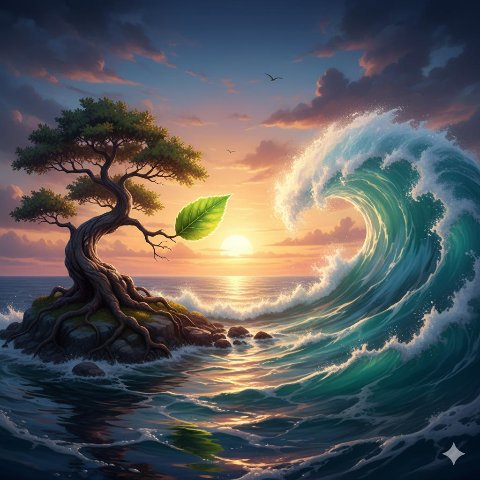
I didn't come into this world; I came out of it, like a leaf emerges from a tree.
This simple shift in perspective holds the key to dissolving the deepest barriers to stillness. The common experience is one of separation: We perceive ourselves as discrete entities—a person, a self, a noun—dropped into a pre-existing world. We see ourselves as being part of creation, a piece of the puzzle observing the whole.
But what if we are not a part of creation, but creation every bit as much as the tree from which the leaf emerged? What if existence is not a static state of being, but a continuous, momentary act of expression?
I am what the universe is doing at this particular moment, just like the wave is what the ocean is doing at its particular moment.
The Problem with the Noun-Self
The idea of the self as a fixed, independent noun—a solid thing with rigid boundaries—is the source of endless friction. This is the ego-self, clinging to its identity, its past stories, and its expectations for the future.
When we are rooted in the Noun-Self, we become obsessed with maintenance and control. We spend our energy resisting what is, trying to hold onto what was, and anxiously trying to force what will be. We fear change because change threatens the solidity of the Noun-Self. This struggle manifests as many of the 49 Barriers to spiritual growth—the clinging, the judgment, the effort, the anxiety that prevents true stillness.
In this paradigm, our actions become heavy. They are driven by purpose and effort, often requiring us to meet force with force. We see the world as something to be acted upon rather than flowed with. Every interaction becomes a negotiation, a battle for the Noun-Self’s survival.
Existence as a Dynamic Verb
The alternative is to embrace the self as a Verb-Self—a dynamic, ever-changing process of expression. The universe is not a static background; it is an infinite act. And we are not spectators; we are the particular way that act is unfolding right now.
Consider the leaf. It does not exist separately from the tree. It is the tree’s annual, moment-to-moment action of photosynthesis, growth, and release. Consider the wave. It is not an object that floats on the ocean; it is the momentary rising and falling, the motion of the ocean itself. The ocean is not lessened by the wave’s peak, nor is it harmed by its dissipation. The wave is simply the ocean doing "wave."
To realize the Verb-Self is to understand that you are not separate from the flow, but the flow itself, momentarily individualized. This realization moves us out of the Wu Wei concept of trying to do less, and into the profound experience of doing from a place of effortlessness.
The Verb-Self in Practice: Qigong and Taiji
Our practices are not about doing the postures correctly (a noun-based goal); they are about experiencing the flow of the universe through the body (a verb-based process).
Qigong and Taiji are training grounds for the Verb-Self. When you cultivate suppleness and flexibility, you are preparing the body to act like water—yielding, adapting, and filling every container effortlessly. The focus shifts from the form’s shape to the “Qi”—the energetic, dynamic action that gives the form life. Sensing “Qi” is not sensing a static energy reserve, but sensing the universe’s ceaseless current flowing through your meridian system.
The application of this is clearest in Push Hands Taiji. The instinct of the Noun-Self is to meet incoming force with equal force. This is the friction of the static self battling the world. But the Verb-Self teaches us to yield. We don’t resist the force; we move with it, using its momentum to complete its own intention. We become the eddy in the stream, temporarily absorbing the current to redirect it without expenditure of our own effort. We resist the instinct to meet force with force by allowing the universe (the other's energy) to flow through our own unique expression (our structure and softness).
Living as the Universe’s Action
When we fully inhabit the Verb-Self, our lives cease to be a burden of struggle and become an expression of grace.
The worries of the Noun-Self—"Will I be successful? Will I be loved? Will I fail?"—dissolve. These are all questions predicated on the idea of a fixed self that must achieve or acquire something. The Verb-Self simply is the process.
To live as the Verb-Self is to trust the Dao. It is a profound, quiet alignment that understands there is no "I" to protect, only an ever-changing expression of the universal flow to participate in. We are not separate from the source of creation; we are the source creating.
The leaf is simply the tree doing "leaf." The wave is the ocean doing "wave." And you are the universe doing "you." Rest in the power of that action.