AI and Artistic Creation
Measuring the Impact
By: CIAC - Nov 23, 2026
We invite you to read a very insightful piece by Andréanne Neveu titled “When AI Redefines the Boundaries of Artistic Creation.” AI is everywhere today and affects everyone. It sparks as much excitement as it does fear. How will AI influence the arts community?
“For several decades, the International Center for Contemporary Art in Montreal (CIAC) has been inviting us to discover art where we don’t always expect to find it. … With its virtual exhibition *AI and Artistic Creation*, the organization continues this dialogue and invites us to discover what AI becomes in the hands of artists, and what it brings to life in their imaginations …”
"Artificial intelligence is often described as a transformative technology whose effects extend across every sector of activity. The arts and cultural sector is no exception. In the arts, AI opens up new possibilities for expression while reviving questions that lie at the heart of art history and the development of artistic techniques. Among them, one fundamental question remains. What role does the artist play when technology participates in the creation of a work of art?"
Preface to the virtual exhibition : AI and ARTISTIC CREATION
For several decades, the Centre international d’art contemporain de Montréal (CIAC) has invited us to discover art where we might least expect it. Its project dedicated to wallpaper offers a beautiful example. In the hands of artists such as Andy Warhol, Kent Monkman, and Nadia Myre, this familiar material, long associated with our domestic interiors, is reinvented as an unexpected meeting ground for visual art, architecture, and design. Their works invite us to see the spaces and objects of our everyday lives in an entirely new light.
What becomes of a medium, a material, a tool, or a technology when artists make it their own? This question runs through the CIAC’s projects and finds renewed relevance today in its exploration of artificial intelligence in artistic creation. From 1997 to 2014, its Electronic Magazine already reflected this interest through the experiments of digital artists. With its virtual exhibition AI and ARTISTIC CREATION, the organization continues this dialogue, inviting us to discover what AI becomes in the hands of artists and what it brings to life within their imagination.
Artificial intelligence is often described as a transformative technology whose effects extend across every sector of activity. The arts and cultural sector is no exception. In the arts, AI opens up new possibilities for expression while reviving questions that lie at the heart of art history and the development of artistic techniques. Among them, one fundamental question remains. What role does the artist play when technology participates in the creation of a work of art? It is worth remembering that photography sparked a similar debate nearly two centuries ago, raising questions about the artist’s role and the artistic value of works produced with the assistance of a new technology. In 1859, Baudelaire challenged the artistic ambitions of a process he considered too closely tied to the reproduction of visible reality (Bibliothèque nationale de France, n.d.).
These questions are therefore far from new. History sheds light on contemporary debates surrounding artificial intelligence while inviting us to reflect on the very nature of artistic creation. Generative AI, however, takes this reflection a step further, as it can contribute to the creation of forms that even the artist may not have fully anticipated. If technology transforms the ways we create, is it not ultimately the artist’s intention, choices, and sensibility that give a work of art its true value?
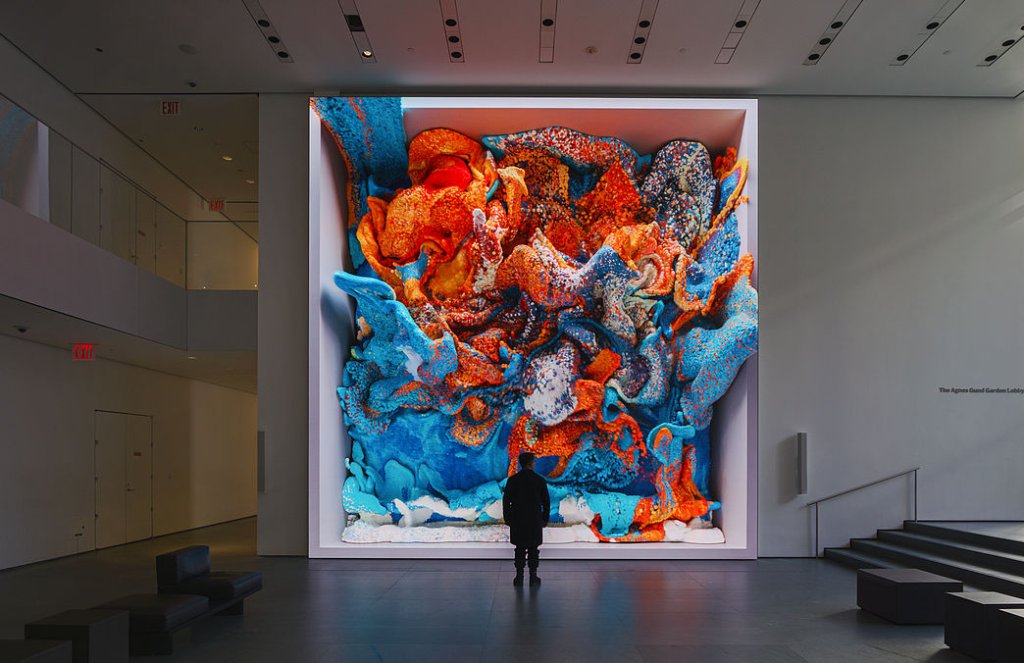
The artistic possibilities offered by this new medium of expression have now reached extraordinary proportions. An artist can explore countless variations of an image, bring archives into dialogue, compose immersive worlds of sound and image, or imagine forms that would be impossible to construct. In digital environments, the physical constraints of materiality, scale, and gravity can be freely reimagined. By embracing these experiments, the Museum of Modern Art (MoMA) in New York and the Guggenheim Museum Bilbao in Spain are helping to establish their recognition as artistic practices in their own right. At MoMA, Refik Anadol’s installation Unsupervised offers a fascinating example, bringing artificial intelligence into dialogue with more than two centuries of artworks from the museum’s collection (The Museum of Modern Art, n.d.-a, n.d.-b; Guggenheim Museum Bilbao, n.d.). Certain tools also allow artists to explore new creative directions quickly, without immediately committing to substantial production expenses. Access to this technology, however, remains unequal, as subscriptions, specialized skills, and computing power all come at a cost. Furthermore, when a creation takes physical form, it remains subject to the constraints of materials, space, and production. Despite these limitations, the possibilities for artistic experimentation are expanding considerably, though they are by no means limitless.
From the artist who imagines the concept and designs the technical systems, to the team responsible for programming them, to the creators whose works contribute to training datasets, and even to the artificial intelligence generating new forms, the number of contributors to the creative process continues to grow. Who, then, can truly claim authorship of the work?
Conceiving a work, selecting data, guiding outcomes, or choosing among countless possibilities are all actions that can form part of an artistic practice. Artificial intelligence does not necessarily diminish the artist’s role, but it invites us to reconsider how a work of art comes into being and how contributions to its creation are shared. Between the initial intention and the final result, the boundaries can become increasingly difficult to define.
Environmental concerns impose another very real limitation. A digital image relies on servers, computer chips, and networks. The United Nations Environment Programme reminds us that assessing the impact of AI requires considering its entire life cycle, from energy and water consumption to the extraction of raw materials, as well as emissions and electronic waste (United Nations Environment Programme, 2024). Its environmental footprint varies depending on the models, their applications, and the infrastructure supporting them. A low financial cost of access does not, therefore, mean that creation comes without an environmental cost. For artists and institutions alike, the question also becomes one of considering the resources required to achieve the intended artistic experience.
Amid this abundance of possible images, the artist’s role takes on particular significance. What should be revealed? What should remain outside the frame? Which experiences deserve our attention? A work may impress through its technical virtuosity yet leave little lasting impression. Another, more understated, may profoundly transform the way we perceive the world. Our encounter with a work of art lies in its ability to make us feel, think, or see differently. Beyond technological achievement, perhaps it is also our very understanding of what constitutes a work of art, and how we come to appreciate it, that is now being called into question.
By bringing together artistic practices and reflections on artificial intelligence, the CIAC invites us to take part in this encounter. Through the dialogue between artworks and ideas, this initiative creates a space where wonder and critical inquiry coexist, without seeking to impose definitive answers. The landscape remains ever-changing, calling for curiosity and open-mindedness as much as for a critical eye.
Artists navigate this emerging territory with their intuitions, their convictions, and their contradictions. Their works offer us an opportunity to experience what is changing, beyond the promises and concerns that accompany technological innovation.
Let us enter this space with our questions, but above all, with a willingness to be surprised. Let us be guided by the artworks and reflections of the artists and authors brought together in this virtual exhibition. When artists embrace artificial intelligence, they push the boundaries of artistic creation and invite us to reimagine the ways we see, think about, and question the world.