

Young Frankenstein
The Wick Theatre in Boca Raton, Fla.
By: Aaron Krause - Oct 29, 2026
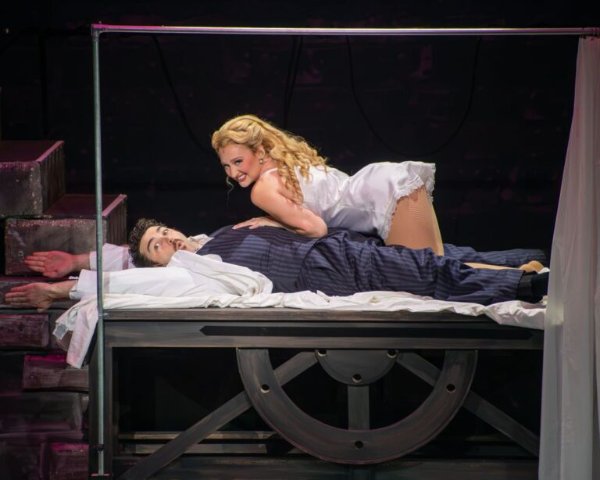
This particular monster may lack CPR certification, but he’s a lifesaver if The Wick Theatre’s creepy and humorous production of the Mel Brooks musical, Young Frankenstein is any indication. Observe as the suddenly civilized creature works diligently to resuscitate the titular character. Certainly, it’s the reverse of what we’d normally expect from a monster story, especially when you consider that at the end, this unnamed monster becomes mayor of a Transylvanian village.
Young Frankenstein has gentle fun with horror films such as the film adaptation of Mary Shelley’s 1818 Gothic and science fiction novel, Frankenstein. Undoubtedly, The Wick’s production, which runs through Sunday in the company’s elegant Boca Raton theater, finds the right balance between playfulness and spookiness. The performance lasts about two hours and 20 minutes, including intermission.
Under Norb Joerder’s skilled direction, the production stars talented performers who imbue their portrayals with just the right amount of parody and sincerity.
The musical’s basis is the classic 1974 comic film of the same title by Mel Brooks and Gene Wilder. While the musical is structurally different, its heart and comedic DNA faithfully match the film classic.
The movie parodies Universal Pictures horror films such as Frankenstein (1931), which drew on the story in Shelley’s tale. In the novel, Victor Frankenstein recounts his life to Arctic explorer Robert Walton, describing how his fascination with the secret of life and his experiences, including his mother’s death, contribute to his ambition to overcome death.
Victor assembles an eight-foot-tall creature from body parts and succeeds in bringing it to life, but becomes horrified by his creation and abandons it. The creature learns to speak and feel, experiences rejection and loneliness, and asks Victor to create a companion for him. When Victor destroys the unfinished female creature, the creature vows vengeance. After the creature kills Victor’s friend Henry Clerval and his bride, Elizabeth, Victor pursues him into the Arctic.
In Young Frankenstein, Victor’s skeptical grandson, Frederick, inherits his grandfather’s castle in Transylvania. With the help of an eccentric hunchbacked sidekick named Igor, a laboratory assistant named Inga, and the ominous housekeeper Frau Blücher, Frederick resumes his grandfather’s experiments. He successfully brings a corpse to life, but a brain mix-up alters the Monster’s behavior, setting the stage for escape, chaos, and comic complications. Young Frankenstein spoofs not only Shelley’s novel and its screen adaptations, but also has gentle fun with musicals, highlighting Brooks’ affection for musical theater.
Joerder skillfully guides the cast. He ensures movement is natural and purposeful and he paces the production at a speed that keeps our interest without letting the action drag. The inclusion of howl-like sounds and stage fog set the scene for a mildly scary afternoon or evening. While The Wick’s production is spooky – and kooky – it never becomes ghastly or gory, so audience members who get queasy easily needn’t worry. The cast demonstrates deft comic timing and gets laughs from verbal and physical humor. While performances are over the top, the actors portray their characters sincerely, rather than beg for laughs. Under choreographer Robert Abdoo, spins and other physical dance movements add energy to an already dynamic production.
Aaron Atkinson’s portrayal of the title character immediately establishes him as a charismatic and supremely confident person who is in his element while teaching his students. He speaks and sings with confidence, and uses what resembles a human brain as a prop, shaking it as he energetically teaches. Later, he sings and dances while handling the brain.
Atkinson’s Frankenstein launches into the rapid-fire, comic patter song The Brain with the smoothness and showmanship of a life-long performer. He sings: Insane! I'm insane about the brain! No invention in the universe is equal to the brain!
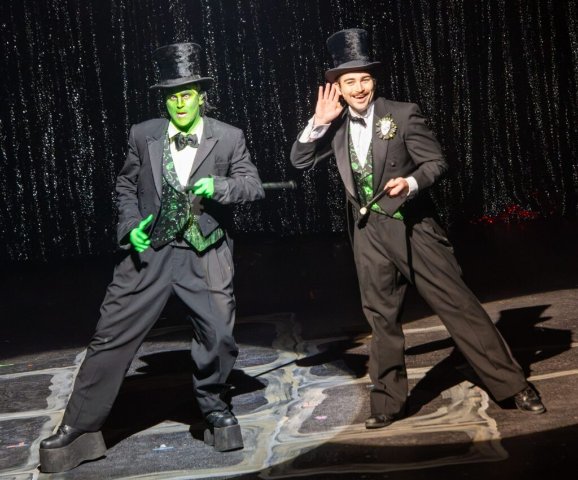
After initial reluctance, Atkinson invests his character with unmistakable eagerness to follow in his grandfather’s footsteps (with the clear understanding that the titular character pronounces his last name Fron-ken-steen, not Frank-en-stein!) At appropriate times, Atkinson conveys palpable frustration when things don’t go well, but he proves resilient and keeps his spirits high. Atkinson also proves to be nimble in his movement, which includes standing on a chair before jumping off, and appearing to effortlessly tap dance in sync with his monstrous partner during the Puttin’ on the Ritz sequence.
Igor (pronounced Eye-gore), whose grandfather used to work for Frederick’s grandfather, soon becomes the title character’s partner in crime. Corey Vega vivaciously yet believably portrays Igor and lends him a dark mischievousness and eagerness. Clad in black, and hunchbacked, Vega’s Igor bows with a flourish, emits an evil laugh, speaks enthusiastically, and seems to relish the chance to help the title character reanimate a corpse. Vega’s Igor demonstrates his excitement about partnering with Frankenstein early on. That’s when his excitement drives him to vibrantly sing a duet with Frederick titled “Together Again.” With a playful, conspiratorial drive, Vega’s Igor joins the title character in the song.
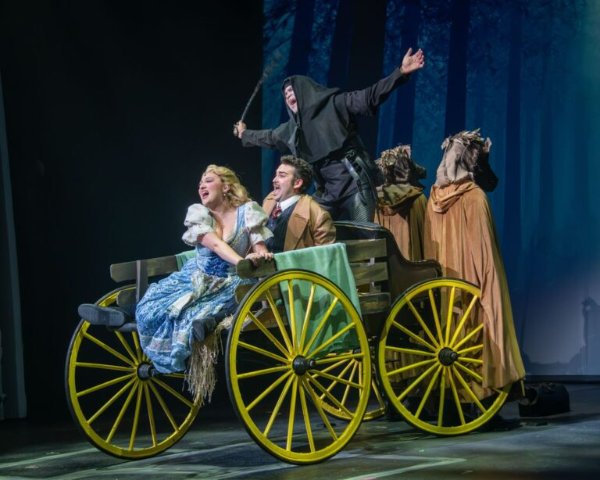
With a radiant smile, accentuated by red lipstick, the bubbly, blonde-haired Katie DeRosa-Tango charms, seduces, and yodels her way into Frederick’s heart -- and ours -- as Inga, Frederick’s young Transylvanian lab assistant. At one point, she hangs upside down and uses high-energy yodeling to flirt with and entice Frederick while they ride in a cart.
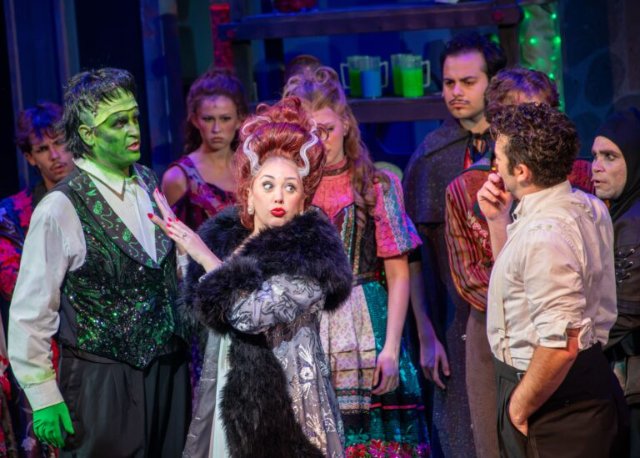
While DeRosa-Tango’s Inga is bright and bubbly, Britte Hammeke’s believable Frau Blucher commands the stage and carries a darkly mysterious air. The character is the Frankenstein estate’s housekeeper and Dr. Victor Frankenstein’s former lover.
Blucher’s solo is He Vas My Boyfriend, with “Vas” establishing her Transylvanian accent. The song’s comedy comes from the juxtaposition of Blucher’s fond, romantic nostalgia with the reality that Victor was completely unhinged and terrible to her. With credible conviction, she sings:
He was a bully und a brute
He vas as crazy as a coot
Still I didn't give a hoot
He vas my boyfriend!
With ev'ry voman he vould flirt
He alvays treated me like dirt
But I vas happy to be hurt
He vas my boyfriend!
With reddish-brown hair and sporting a sparkling red costume, matching her red lipstick, Leah Sessa is elegant and larger-than-life as Frederick’s fiancé, Elizabeth. The performer’s ability to growl while singing reinforces the character’s strong personality. Sessa’s Elizabeth is self-loving, seductive, and seemingly fearless.
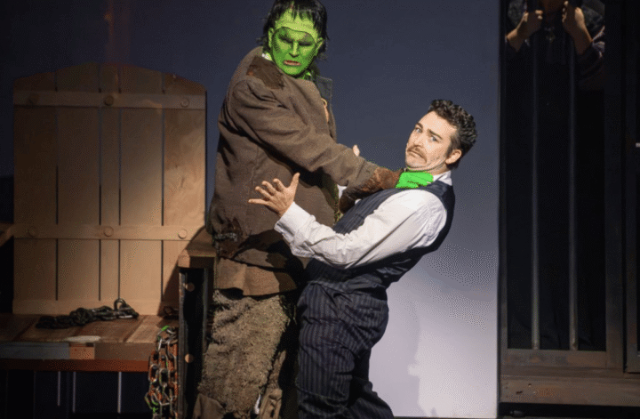
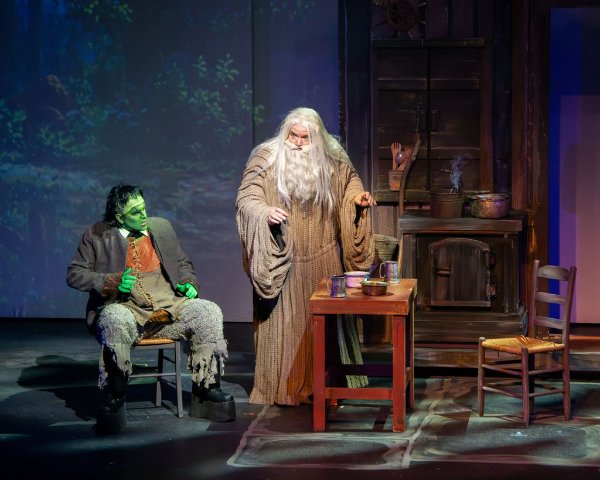
Thomas Porat is unrecognizable as the tall monster, sporting green makeup, lumbering across the stage, and speaking awkwardly. At one point, a hermit (a vulnerable Shane Tanner) hands the creature a bowl and he looks at the object as though it were an alien. Porat’s creature sits up slowly, shakes, and screams in the lower register. Later, he proves to be agile as he dances seemingly effortlessly to Puttin’ on the Ritz in a Transylvanian theater alongside Frederick.
The monster may call to mind Eliza Dolittle in My Fair Lady; he, too, undergoes a transformation from awkward and unrefined to polished. Toward the end, after Frederick transfers some of his smarts to the monster, the creature acts with convincing urgency to save Frederick, not dead, but unconscious following a hanging. The fact that the monster revives Frederick humanizes him, making him something more than a creature. After his transformation, Porat’s monster speaks gentlemanly and acts decisively.
“Less than an hour ago he was a dead monster, a hulking beast, and now he's alive and talking like Noel Coward,” someone comments.
That individual is Inspector Kemp, the local one-eyed, one-armed police inspector obsessed with law and order in Transylvania. Tanner plays him with a convincing stern demeanor, and the inspector seems doggedly determined to find the monster.
Tanner is part of a strong supporting cast, which includes ensemble members portraying a mob-like group concerned about the monster. They recall the gang in Beauty and the Beast, terrified of the havoc they feel that titular creature can cause.
The cast succeeds along with a talented group of behind-the-scenes artists.
The production seamlessly moves between four distinct settings: Frankenstein’s lecture hall, a Transylvanian village, a spooky castle, and a laboratory. Gothic touches extend beyond the stage; we see them even before we enter the Wick’s building. Gravestones with the letters “RIP” rest just outside, whetting our appetite for the spookiness to follow.
The horrific theme continues before the show begins, when a projection screen displays the show’s full title accompanied by an image of bats. The screen later displays an image of a dark, imposing castle. Dark-colored scenery, stage fog, as well as lightning and thunder help to further establish a Gothic presence, and images on the projection screen help to flesh out that atmosphere.
Scenery slides onto the stage, allowing for seamless transitions between scenes. At one point, the characters are riding to the castle on a horse and buggy. The projection screen moves, creating the illusion that the vehicle transporting the characters is in motion. Kimberly Wick, vice president and associate producer of The Wick Theatre & Costume Museum, is the set coordinator.
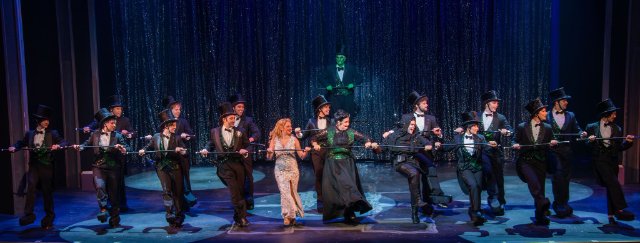
Alex Worthley’s lighting design incorporates bright, realistic illumination for upbeat scenes such as the Puttin’ on the Ritz sequence. The lighting also flashes during this scene, enhancing its theatricality. Also, Worthley uses hues such as purple for more romantic scenes, establishing a darker, seductive aura. In addition, green lighting emanating from containers lends certain scenes an otherworldly quality.
Sound designer Justin Thompson helps ensure that we can clearly hear and understand the lyrics and spoken dialogue. In addition, spooky sound effects contribute to the overall aura. Musically, the production uses prerecorded tracks rather than live musicians, and those tracks ably accompany the performers (the music director is Bobby Peaco).
Costume and wig designer Johnny Gagno outfits Frankenstein in a white lab coat, which helps to establish his profession. Meanwhile, Elizabeth’s red sparkly outfit reinforces her wealth and high society position. Black top hats, matching suits, and canes lend a sense of style as characters tap dance to Puttin’ on the Ritz. While the color black suggests elegance and formality, it’s also an appropriate hue for this darkly funny and creepy show.
Young Frankenstein’s score, with music and lyrics by Brooks, blends traditional Broadway showmanship with satirical pastiche. Much of the score relies on classic Golden Age and modern Broadway idioms, complete with big ensemble numbers, belt-heavy character songs, and high-energy showstoppers. In addition to comedic patter songs, the score also leans into classic vaudeville routines and catchy, old-school melody structures.
Listen carefully, and you’ll hear in the score similarities to other familiar and beloved Broadway shows. For instance, in The Brain, the medical students sing There is Nothing Like a Brain. This is a direct melodic and structural parody of the classic sailors’ chorus, There Is Nothing Like a Dame in South Pacific.
In Young Frankenstein, Inga uses high-energy, rapid-fire yodeling in Roll in the Hay. Listen, and you may hear a similarity to Maria Rainer’s yodeling in The Lonely Goatherd in The Sound of Music. But whereas Rainer’s yodeling is wholesome, Inga’s is suggestive and flirtatious to entice Frankenstein.
You may also notice a similarity to the Brooks megahit, The Producers. We Can Do It from that show and Together Again from Young Frankenstein serve the same narrative purpose: an energetic, fast-talking character is trying to convince a hesitant person to team up with them. Of course, The Producers and Young Frankenstein are vastly different shows. The former satirizes Broadway and show-business ambition while the latter derives much of its comedy from spoofing horror films and the Frankenstein story. Young Frankenstein’s songs aren’t quite as memorable as those in The Producers.
In the end, The Wick’s dynamic production of Young Frankenstein nicely balances spookiness with parody, along with some tunefulness, creating an afternoon or evening of laughter and mild shivers from eeriness that probably won’t keep audiences up all night. Consider it a warm up for scarier, gasp-inducing fare this Halloween.
The Wick Theatre’s production of Young Frankenstein runs through Sunday at the company’s Boca Raton venue, 7901 N. Federal Highway. Remaining showtimes are 7:30 p.m. Thursday, Friday, and Saturday, as well as 2 p.m. Saturday and Sunday. For tickets, visit https://thewick.org.