Share

Raphael Soyer Spanning Seven Decades

At Forum Gallery

By: - Oct 27, 2026

Continuing at Forum Gallery is a special presentation of paintings by Raphael Soyer (1899-1987). Spanning six decades, the works on view offer a personal pictorial language rooted in the people and locations of New York, the city Soyer once described as “my country.”
 
At the age of twelve, Raphael Soyer and his family left Russia and immigrated to the United States, settling in Manhattan in 1912.  In his youth, Soyer roamed the streets, sketching scenes of the Lower East Side. Following the devastating events of 1929, he turned his attention to the drifters, derelicts, and those struggling from the impact of the Great Depression.  Soyer painted scenes he observed from the Bowery to Fourteenth Street, in the Hoovervilles known as “Packing Box City” on Houston Street, and “Hardlucksville” on the East River, and not far from the Bowery Mission where New York City’s homeless converged for food and shelter. Soyer often befriended his subjects, offering compensation or a night's lodging in exchange for their time sitting for a portrait.  Some became recurring models for Soyer in empathetic paintings depicting the lives of the working class with great dignity. 

Men at the Mission, 1935, is emblematic of Soyer’s paintings of this period.  The work features Walter Broe, an out of work businessman and a favorite model of Soyer's and others of the "Fourteenth Street" group of artists.


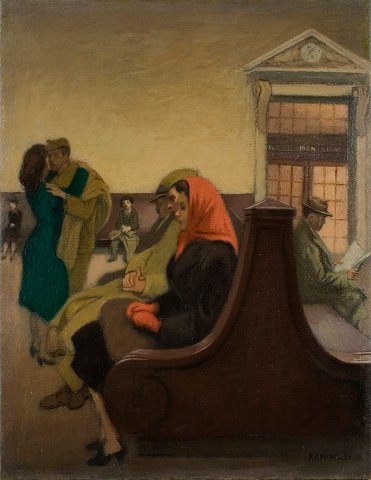
Raphael Soyer, Waiting at the Station, c. 1941, oil on canvas, 18 x 14 inches


Throughout his life, Soyer’s urban scenes were inspired by the changing times, attitudes, and social activities he observed. In the late 1930s, Soyer became interested in waiting rooms. The drab theme of people sitting and waiting fascinated him - their moods of weariness, impatience, or resignation compelling his attention.  Soyer visited New York’s transportation hubs, especially train stations, but as the United States entered World War II, the “waiting room” subject assumed new gravitas. Soyer took himself to Pennsylvania Station at 34th Street to observe the human impacts of war. In short succession, a small group of train station paintings emerged from Soyer’s palette capturing a nation activated, and the profound human toll incurred, in emotional scenes depicting soldiers and loved ones saying goodbye. 

Waiting at the Station, c.1941, at first appears to be a quiet waiting room scene, but it in fact captures a scene of complex emotions in the men and women depicted, transfixed in their own differing psychological moments. The heartrending portrayal of the young solider and his beloved embracing to the left of the composition contrasts with the seeming emotionlessness of the foreground figures, uniting themes of weariness and isolation of modern urban life with the dread and grief of war.

In his recent writing about Soyer’s paintings of urban life for The Wall Street Journal, Brian P. Kelly highlights the Artist’s lifelong admiration for the strength of women in his discussion of Waiting at the Station:

“As we look more closely we realize that not only has Soyer captured evocative moments documenting the realities of the rapidly changing world around him, he also actively contributed to that change by championing the strength of women at a time when second-wave feminism wasn’t even a ripple. In (a) painting of soldiers departing, a woman sits stoically in a train station—she seems to either have just said goodbye or is preparing to. Nevertheless, she remains strong, her erect posture evincing her self-con?dence that she is more than capable of managing the di?cult time ahead."


Raphael Soyer, Study for Barefoot Girl, 1969, oil on canvas, 14 x 12 inches


In the late 1950's and 1960's, the Soyers lived on Second Avenue, in the heart of the East Village, New York's avant-garde artistic and literary center of the time.  As seen in his Depression era paintings, Soyer was attracted to those living outside of conventional society and he found endless inspiration on the streets of the Village outside his studio. Soyer’s street scenes of the period, including Study for Barefoot Girl, 1969, on view at Forum Gallery, embraced the bohemian youth that, to him, radiated vitality. Simultaneously, his depictions captured the spirit of this time of intense social change. Study for Barefoot Girl is a lively precursor to his major work Avenue of the Americas, a 7-foot wide, multi-figure painting now in the collection of Grey Art Museum at New York University. 

Following the opening of Soyer’s retrospective at The Whitney in 1967, Jeanne Paris wrote for the Long Island Press:

“The dynamism of his work is such that even those who choose to withdraw from society, whether they be the derelicts caught up in the depression or the Hippies of today, all are swept into the maelstrom of the living…Because he cherishes life in all its forms, he frequently beautifies that which is most sorrowful…The inhabitants of the East Village, become bohemian intelligentsia and a simple girl of the East Side, a madonna. The true greatness of Raphael Soyer lies in his overwhelming sensitivity. When he paints, one sees the paint on the canvas, but behind the canvas there is something greater, his feeling and responsiveness.”

We hope you will visit us to Raphael Soyer on view now at Forum Gallery. Following November 14th, works by Raphael Soyer can be viewed by appointment.


You are invited to preview Raphael Soyer by visiting our Online Viewing Room.