

Part III: The Burden and Grace of the Family Name
The Well
By: Cheng Tong - Oct 20, 2026
When a practitioner is granted a practice name or formally received into a lineage, the mind instinctively reaches for metaphors of arrival. We are wired to treat formal recognition as a summit reached, a door locked behind us, or a badge affixed to the chest. In a culture obsessed with credentials and status, a lineage title easily becomes a trophy of completion—proof that the work is finished and authority has been claimed.
In the Daoist arts, however, a practice name is not an arrival. It is an agreement to step into a deeper stratum of responsibility. It is not a crown to wear, but a vow of continuation.
To receive a name is to acknowledge that you are no longer operating merely as an isolated individual tending a private garden. You have been folded into an ecosystem that predates you and will outlast you. You have ceased to be just a leaf competing for light on the outer branch; you have agreed to become part of the root system that keeps the living tradition fed.
Every true lineage carries both a burden and a grace, and the two are inextricably bound.
The burden is one of accountability and self-correction. When you carry a practice name, your conduct ceases to be entirely your own. Your impatience, your arrogance, or your carelessness no longer reflect solely on your personal temperament—they reflect on the collective vessel of the art itself. The name acts as an unyielding mirror. It demands that you constantly refine your motives, strip away personal ego, and measure your actions against the principles carved out by generations of practitioners before you. It is the weight of knowing that a lineage can be degraded far faster by the carelessness of its stewards than by the attacks of its detractors.
Yet within that weight lies an extraordinary grace. To step into a lineage is to step out of isolation. You no longer have to invent the path from scratch or rely solely on the thin reserves of your own strength. Behind you stands a continuous line of ancestors, teachers, and refined principles—a deep reservoir of wisdom tested across centuries. When your personal resolve wavers, the lineage holds the form. When your understanding falters, the lineage provides the structural boundary within which clarity can re-emerge. The grace is the realization that you are supported by something vastly larger than your individual ego.
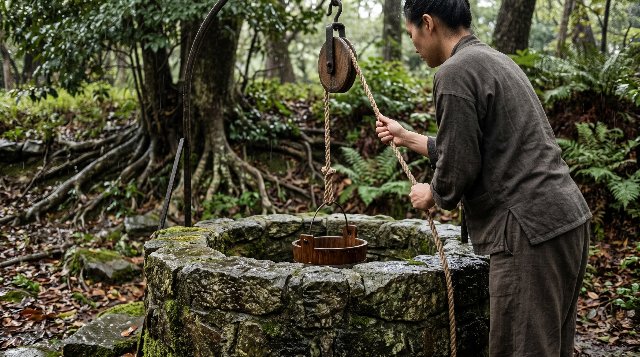
Consider the nature of this stewardship through a simple image: you have not been handed a reservoir of clean water to store in a private cistern. You have simply been given a bucket and shown the hidden path to a very deep well.
The well was dug long before you arrived. Its waters are cold, pure, and constant, supplied by underground streams you cannot see. But the well does not draw its own water. The stewardship lies entirely in the unglamorous, repetitive daily discipline: walking the worn path, lowering the bucket into the dark, and hauling the weight back up into the sunlight.
If you stop drawing the water, the well remains, but those around you go thirsty. If you draw the water only to splash it about in display, you waste the effort of the climb. The daily practice is meant to keep your own vessel clean and clear so that when others approach—weary, uncertain, or seeking guidance—you have something fresh and nourishing to offer them. Lineage is not a boundary that separates the elite from the uninitiated; it is a service conduit that connects the deep spring to the thirsty world.
As we look toward the final movement of this series, we see that the trajectory of practice inevitably moves outward. We began by relaxing our grip in The Open Palm, moved beyond static structures to underlying principle in Clear Glass, and now find ourselves grounded in the collective responsibility of The Deep Well.
The strength of any living lineage is never measured by the titles carved into its historical ledgers, nor by the prestige assigned to its names. It is measured only by the clarity of the water pulled from the well today—and whether those