

Simon Stone's Cherry Orchard
Park Avenue Armory Goes Korean
By: Susan Hall - Sep 21, 2026
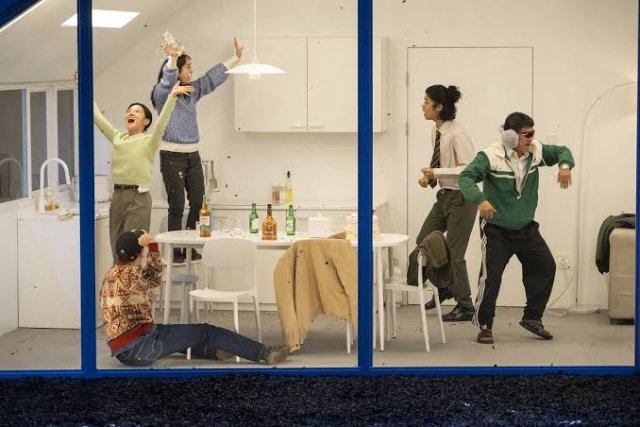
What is striking about the current production of The Cherry Orchard at the Park Avenue Armory in New York is its musicality. You notice this quickly, because, if you’re like most of us, you don't understand the Korean language spoken in this version of the play. It was written by the brilliant director Simon Stone, who says he wanted to "pin words onto his actors." You clearly get the emotion of the phrases—they chirp and tinkle and chip away at the air like musical notes.
It is best if you know Anton Chekhov’s last play well. He set it in Russia as the revolution loomed. Society as Russians had known it, with a wealthy aristocracy and masses of serfs, was evaporating, and no one knew quite what to expect.
Joseph Roth wrote about a similar period in Austria. His The Radetzky March, about the fall of the Habsburg Empire, is both funny and sad, like Chekhov’s work and now Stone’s. Think about the beginning of the 20th century, when cousins fought each other on the battlefield during the day and then ate dinner together at night.
Stone has moved the plot to present-day Korea. He reports being influenced by the film Parasite, in which the classes clash. Yet we do not get the strong feeling of an ending and a new beginning that Chekhov gives us.
Instead, we explore the interior lives of the characters Chekhov first proposed. Each of them is both good and bad; their foibles are at first funny and then sad.
The set by Saul Kim is visually exciting. The outline of a house belonging to a rich Korean family features crisp steps extending as a roof and reaching from roof to ground. The action takes place in a claustrophobic glass house where we can watch the characters suffocate. A maid cleans for almost the entire play; I doubt there is a speck of dust left after she finishes.
Still, I missed the wealthy lead woman’s donation of gold to a beggar when she can’t find silver, forgetting that she herself is broke. I missed the old servant, Firs.
Of course, West Side Story was not called Romeo and Juliet. Rosencrantz and Guildenstern Are Dead was not called Hamlet. Calling this play The Cherry Orchard may be a bit over the top. The Songs are a chaebol family neglecting their business. Jeon Do-yeon is both gorgeous and compelling as a reckless corporate heiress, while Park Hae-soo is stalwart as the chauffeur's son who buys the family estate.
Oddly, the costumes make the actresses appear to be the same age, rather than dividing them between youth and old age as Chekhov does. But our focus remains fixed on their inner lives.
Ultimately, the evening thoroughly engages the audience, who are swept up by the emotional and musical language.