

From Call It in the Air
What Do You Know About War
By: Gregory Light - Sep 03, 2026
(Toronto 1972)
‘Dan Spear?' Gary drawled the next morning. ‘You gave them that name?’ Joey had opened his eyes, his head pounding under the double onslaught of an early morning hangover and the unshakable belief he would never see Joanna again.
'Get lost,' Joey scowled, turning his face toward the wall.
'Dan Spear knows no fear,' Gary slipped an imaginary six-shooter out of an imaginary holster. Joey winced. Dan Spear was not funny anymore. Just a disturbing mistake Gary sprung on Joey whenever the occasion called: a derisive reminder of the day a young cowboy sat on his front steps and claimed he was running off to Texas.
'Forget about her,' Gary said spinning the gun on his forefinger, 'she ain't worth the trouble.'
'It's the kind of trouble I like!' Joey shouted, trying to clear his head.
'Pow!' The six-shooter blazed. 'Try laying low for a spell,' Gary snapped. ‘That seems to work for you.’
Joey waited for the follow-up, but it didn’t come. Gary was gone.
Joey looked at his alarm clock. Nearly nine. Wednesday. Four days since Joanna had hung up on him. And still not a peep from her. He pulled the sheet over his head. 'Sleep, give me sleep.'
It never came. A minute later, his door crashed open. McDougal. One day I'll kill him, I swear it, Joey thought. McDougal stayed cautiously in the corridor until the door had bounced feebly back. After the last incident, not yet three weeks old, he was taking no chances. Joey was surprised to see how quickly the bruising on McDougal's face had subsided. The bastard's going to look even better than he did before.
'Edwards, Edwards, Edwards,' McDougal said, striding into the room. He slipped two envelopes from a sheaf of mail in his hand. 'Yup, here you are. A couple of letters.'
'Letters?' Joey twisted in his sheets. His first thought was Joanna. She had written him. A sweet, loving apology.
'One of them is from Paris. Very mysterious. Who is S.I.P.I.?’
‘It’s an academic thing.’
‘Boring!’
‘George, just give me the letters.’
‘Wait! This other one is perfumed,' McDougal said, raising it to his nose and teasing Joey into getting out of bed. 'Holding back on me, eh Edwards?' He offered Joey the letter but quickly snatched it back when he reached for it. 'Not so fast. Who is she?'
'How the hell am I supposed to know?’ ‘I haven't opened it.' But he knew. It was Joanna. Who else?
'Her name's Sarah. No last name. Just Sarah. Very romantic, Edwards. A letter from a woman with no last name.'
Joey was shattered. 'For god's sake, George, look at the return address.'
'Manitoba. She lives in Winnipeg. A prairie dog. Tricky. You wouldn't dare find a lady here. You know I'd take her from you: even if you had destroyed my face.'
'It's from my grandmother. Hand it over and get out of here.' Joey slipped into his jeans.
'Your grandmother?' asked McDougal, disappointed. "Why is it perfumed then?'
'It's the writing paper she uses. Now come on, George, I'm up, I'm out of bed. You've served your moronic purpose. Get out!' He was in no mood for fooling around. Joanna hadn't written. McDougal tossed the letters on the desk and left.
Joey put aside the letter from his grandmother to read later and opened the other. La Société International de Psychologie Inorganique. Beneath the logo were two addresses: the international headquarters on the Rue des Saints-Pères, in Paris and a Toronto address at York University.
Dear Sir/Madam,
Due to phenomenal growth in the field of Inorganic Psychology during the last few years, we are proud to announce the formation of the International Society of Inorganic Psychology based in Paris, France. This new academic society has …
Blah, Blah. 'My God!' Joey breathed. It was over a year since he'd told Clements ‘to eat shit’ and they still had his name down on a list. He skipped down a few paragraphs.
If you are interested in further information on this society, our quarterly newsletter, The Mind of Matter, and/or the purchase of books (enclosed find a list of titles), please fill in the form provided and post it to the address above. We trust you will find the work of this new society both stimulating and exciting.
Sincerely Yours,
Robert Kozak
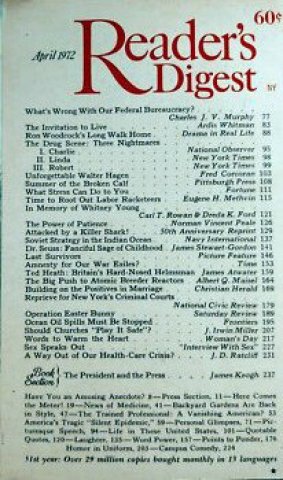
Kozak? That was the name of the graduate student who had seen him? Joey shrugged and turned to the enclosed order form, half expecting to find boxes for tee shirts and buttons. He was drawn into the odd list of titles. He chuckled with delight. His curiosity, unusually susceptible to published oddness, almost persuaded him to put a tick in the box beside The Pathological Effects of Cubist Art on Twentieth-Century Furniture. It was perfect for his growing collection of contemporary nonsense; "junk food for the head" he called it. He rarely spent a more pleasant afternoon than one browsing second-hand bookshops, chasing down the intellectual debris of the day: the ludicrous, the preposterous and the absurd. His library consisted of titles like Countdown to Zero, which, among other things, issued an apocalyptic warning on the fate of black & white television sets by the year 2000; or, a favourite, a Reader's Digest publication entitled New Hope for Those Who Have Everything; except, the book points out, research funding to study the problems such affluence brings.
He was only dissuaded from buying this latest title by the price tag. He figured, in a few months, he'd be able to pick it up for 99 cents at the Cut Rate Books Emporium on Dundas Street, shamefully remaindered along with many noble cousins. For all its progress, the Twentieth Century was a particularly fertile breeding ground of the stupid idea; the walrus and the carpenter, he called them: "Stupidity and Progress were walking hand in hand ..."
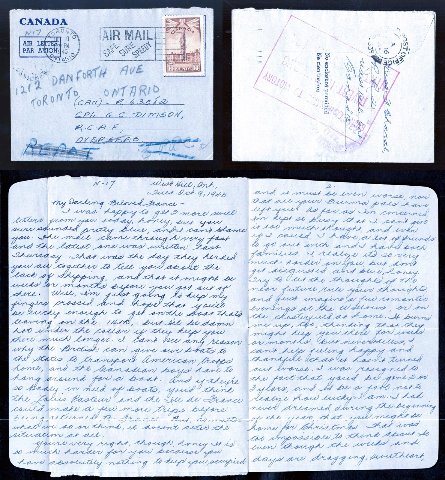
He folded the S.I.P.I. letter, pushed it back in its envelope and slipped it into another of his "junk" books, Curing the Sneeze, for future reference. He gently lifted his grandmother's letter from the desk. It was written on an aerogram which required great care to open. Sarah’s handwriting had recently turned obsessive and mean, dogged by a fastidious fingers insisting the pen use every available bit of space; so much so, that she often scrawled three or four sentences over the gum used to stick the flaps down. Determined to read it all, Joey would spend half an hour steaming open her aerograms and another half hour deciphering the blurred words on the gum.
The steam from Joey's kettle enveloped the aerogram, loosening the gum and enhancing the scent McDougal had noticed earlier. A gentle, fresh fragrance. Sarah had started dusting her letters with this scent in 1943. On the same day she received her first piece of war correspondence, a letter from Joe, which seemed to her to have arrived, like a "magic pop", from another dimension. From a place—the war—of which she had no tangible impressions.
When she read (again and again and again) Joe's first letter, she found herself envying his life, envying the concrete realities his words evoked. Although he had yet to see action, his sentences were filled with new experiences, with words that touched the senses; words she was surprised he knew how to spell. Even his descriptions of their Manitoba farm—the very room in which she sat reading his letters—seemed more real than her own perceptions of them: paragraphs on the sights and sounds and smells of the "doddering old, shed round back" or the ‘warmth and comfort’ of their bedroom. Above all, he wrote about the pleasure he got from her letters; how all thoughts of the war—which his pencilled lines described in meticulous detail—were driven from his mind when he read them. And then he would write about her, about the soft cotton of her dresses, about her hair when she let it down, or the unmanageable curl that always flopped across her forehead when she put it up. It's the smell of yourself that does it most, Sarah, he wrote. It sort of sticks itself to the page and goes around like a sergeant major, ordering all the words to attention. It's something to feel, eh? It makes me see you right here in the barracks with me.
With her next letter, Sarah began the practice of scenting them. And it stuck, becoming over the years, a vital quintessential part of her writing; a natural step between writing the letter and sealing it. It was a custom Joey learned to appreciate while still young, and as his love for his grandmother flourished, it served as a reminder of how deep and uncomplicated his feelings for her were. It signified love from someone who had always understood him, even when he had trouble doing so himself. It was an exceptional understanding which, now, as she aged, he was able to reciprocate. Understanding Sarah came easily to Joey, although, at this point in her life, it was apparently difficult for almost everyone else.
Over the last half-decade, Sarah's behaviour had begun to show the cruel symptoms of creeping senility. It was her letters that first revealed this to Joey. In the last couple of years, especially, they had become less coherent; first in punctuation and spelling and then in expression and thought. With this most recent letter, he was deeply grieved to see his name and address had been added to the envelope in a different hand.
Joey knew that Sarah was no longer always capable of remembering what names and addresses went together. In mid-sentence she sometimes looked up helplessly, tears freckling her eyes, to ask to whom she was writing and how she knew them. To spare Sarah further pain, Joey's mother had tried repeatedly to discourage her from writing, but she had refused to stop. She stubbornly insisted on writing daily, rising early every morning to organize her thoughts, and arrange people, places, and names as best she could. She would spend hours checking and cross-checking her memory against old letters and photographs which she laid out on a green card table in the corner of her room as assiduously as some people kept stamps, coins, and baseball cards. Despite her lapses with faces and names, however, Sarah was able to place Joey with clarity. And when she wrote him, her letters displayed a purity of expression and sentiment which he delighted in reading.
Dearest Joey,
I have been wrestling with the words I wanted to write to you since lunch. My hand is steady as ever, but it spends too much time waiting for my head. Then gets bored and falls asleep, waking up suddenly with thousands of sharp little pains, angry with me for being the doddering fool I am. I fear it might make a secret alliance with your mother to stop me altogether. It's already taken to saying that I should stop my weeping as it doesn't matter what I say. Imagine! What am I being told? I've taken to speaking the words aloud as I write so I won't be tricked.
Joey was disappointed to see that Sarah's spelling and punctuation had been corrected in different coloured ink. He wondered how long it would be before sentences and expressions were re-arranged. It thrilled him, then, when he read the distinct lines of Sarah's rebelliousness.
I won't be tricked out of what's left of my life just because my memory doesn't come when it's called. My voice still does.
So far, so good, thought Joey. But he was aware that her times of lucidity were preceded and followed by opaque times. He read on with the boyhood apprehension he had when stalking birds with Gary in a nearby field, treading as quietly as possible in the dried undergrowth. He realized her voice, aloud or not, could falter on any phrase. He was prepared for it but saddened when it happened again.
I can hear it even when it whispers but I won't pretend it's a secret. I never kept secrets except when I knew nobody else cared. That's important. I told Joe that. He was quiet and I told him I cared whatever he said but he didn't tell me until after he came home. Imagine! Took a war to open his mouth. If the Lord sent the war for no other reason, I'd understand, except when I say it, they say, shame! But it opened his mouth. Canada, he said, is an awful place. He didn't know why, but he said it. Said he could never say he was Canadian like he used to say it. With pride. Now it makes him cry. It makes me cry too.
This section of the letter had many furious lines scrawled over it in different colour ink. It appeared to Joey like primitive censorship, but he could not see another hand behind such a thing. Later in the letter, Sarah confessed to having made the marks herself.
If I said the pen slipped or that my fingers are not as strong as they were, you would know wouldn't you, because I've told you, haven't I?
She had told him. And he understood the feelings behind the wild scribbles. He could visualize the drama that underpinned the letter in his hand; a painful, sad drama that splashed out for a moment and was quickly hushed up. While writing the letter, Sarah's voice had suddenly lapsed, fixing onto another memory which her hand had obediently followed, transcribing word for word. It was self-betrayal and she had immediately taken steps to conceal it, stabbing lines across the words until she realized to whom the letter was addressed. Joey. He already knew so she stopped.
The subject of the passage was not new to Joey. If it had been, he might have been hard-pressed to understand the words. But he'd listened to her mention it before; with such feeling that he was convinced it was the most important episode of her life. He came to expect some reference to it, however tiny, in every letter.
In her last letter, this reference had been oblique. What do you know about war? It struck him because of where she had placed it. Immediately after the salutation: "Dearest Joey. What do you know of war?" No other mention. Momentarily he had wondered if she expected an answer. She hadn't. She had simply recalled the relationship that existed between them and the circumstances to which it related: the day she had first posed the question—Dominion Day 1967. The entire population from Newfoundland to the Yukon was celebrating the 100th anniversary of Canada's independence—Sarah's voice possibly the only dissenting words in the country.
'It's incredible,' Joey said, turning from the television where he had been watching coverage of the anniversary.
'What?' asked his grandmother, entering the room with a tray of sandwiches and cold beer; the centenary menu.
'Independence Day,' Joey replied in error, confusing the name with the American holiday three days later. 'The hundredth?'
'... the hundredth anniversary of Confederation
Everybody, sing together, Cannn-aa-da ...'
The song sprang joyously from the television.
Sarah mumbled "Oh" quietly and set the tray down on the coffee table. The event made her feel uneasy.
Joey saw the worry on his grandmother's face and turned the volume down on the television set. It was unusual for Sarah to be so ill at ease. 'If something is bothering you, Gramma,' he said earnestly, 'You can tell me. I'll understand. I promise. I'm sixteen now.'
Sarah looked up at him, moved by the sincerity in his eyes. She smiled. Perhaps he would understand. She believed he would. Her doubts had less to do with Joey’s age than with her ability to express herself. 'Maybe later,' she said softly. Joey's parents had entered the room. They settled down beside Sarah on the sofa.
Ottawa. Dominion Day. One Hundred Years. The flags and the events and the singing continued well into the evening. Joey left the house after dinner to attend the celebration organized at the local park, hoping he might bump into someone; maybe run into a couple of girls from school. He ran into the wrong girls and had to leave before the fireworks to get away from them.
'Did you enjoy yourself?' Sarah asked. She was reading. She looked up when Joey came through the back door.
'Yeah,' he replied glumly.
'No, you didn't'
'That bitch, Marlene!' Joey fired spontaneously.
'Joey!' Sarah admonished.
'Well, she is.' Joey's language was a bone of contention between him and his grandmother; it was one area he'd get no quarter from her, so he tried to restrain himself. 'Do you know what she did? Do you? She stuck me with her little sister.'
'It couldn't have been that bad.' Sarah smiled.
'A ten-year-old brat! And I got her so she Marlene could dance with Martin. One dance she said. They didn't come back for two hours. Martin owes me for this. Stuck talking to a ten-year-old for two hours. Hell?' the clean words wouldn't come, 'I mean she kept winking at me.'
'She liked you.' Sarah sensed Joey's frustration but smiled. 'You should be flattered.'
Joey groaned. 'She's ten years old.'
'And I'm almost seventy.'
'That's different.'
'Why? We can talk.' She held his gaze for a second.
'But you're my grandmother,' he said plaintively, sprawling his gangly frame into the armchair nearest her. Sarah put her book down and patted his hand. She looked at him for a long moment and then leaned over and brushed his hair from his forehead. Joey knew she wanted to talk.
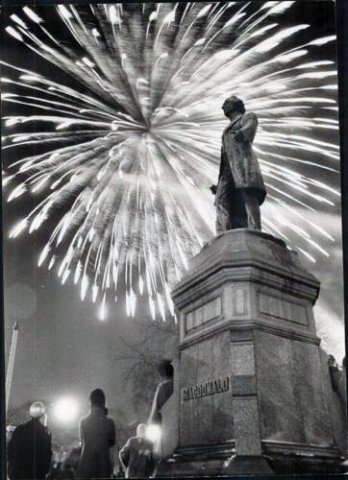
'Joey,' she said hesitantly. He looked so young; but he was tall, resembling his grandfather more every year. ("I'll understand. I'm sixteen.") Sixteen. It didn't seem like much. She hesitated. A few blocks away the first fireworks exploded into the sky. Faint flickers of red or blue or green filtered through the window, preceding the muffled sounds by a second or so. Grating across Joe’s descriptions in his letters, these salvos of Canada's centennial rekindled the difficult feelings she had tasted earlier, their frightening associations prompting her to speak. 'What do you know about war?' It tumbled out accidentally, as if the question was no more than a stray collection of words that simply got together.
It made Joey shiver. 'I'm not sure I know what you mean,' he said.
'Joe knew,' she continued, a hush in her voice. 'He was there during the war.' She emphasized the word "there" as if it was the commonplace of all wars.
'The Second World War,' Joey said. 'He was in it?' Joey remembered seeing two photographs of his grandfather in military uniform. Sarah rarely travelled without them, putting them out on the night table beside her bed. They were "Before and After" pictures. That's what she had told Joey when he asked about them. At first glance, they looked the same; both taken from the same point of view, outdoors and from the waist up. In both, his grandfather was wearing his army cap at the same askew angle and was smiling. Joey, however, had been struck by the fear baked into the eyes of the second photograph, taken late in 1945.
'He was one of several thousand volunteers from Manitoba,' Sarah said. 'He was there for the last years: in Germany when it ended.' Two blocks away, a large white rocket burst into tiny stars. Sarah's eyes glittered for a moment. Then there was a sharp explosion, followed by cheers. 'Your grandfather was a quiet man, Joey, but what he saw there after it ended ...' she looked away. 'It was all he could talk about. Night after night. But, we were talking, and I thank God for allowing us that.' Sarah took a trembling breath and looked up at Joey. Her face was tense. Her deep lines and wrinkles magnified, like the uneven array of furrows he'd seen in the ploughed fields of her farm. Eventually, these lines began to fill with tears. 'He never understood why they hated us with such anger.'
'The Germans?' Joey asked softly.
'The people the Germans put in those camps. The people Joe, helped to free. They hated him. Hated Canadians. That's what he didn't understand. When he told them where he came from, he was spit at. His only wound came from a young boy who threw a stone at him and cut his ear. She said, this old woman said, she'd rather be liberated by the French or the British or the Americans, even the Russians, but not Canadians. Never Canadians. She refused his help, saying she'd rather be shot, rather die, rather?’ Sarah couldn't control her crying now. She bent forward, holding her face in her hands. 'He couldn't be saved by the countless thanks of others. I told him it was only a few people. Very hurt people. But it was too late. I couldn't help him.'
Joey didn't speak. It was too distant, too adult, too strange to grasp.
The celebrations in the park became sharper now. His senses latched onto the explosions and flashes to pinch his numbness. He wanted to understand. He desperately wanted to care. He reached over and stroked his grandmother's hair as she had touched him in the cemetery. Suddenly, he felt useless. Guilty! Sharply conscious of his age and youth, of how much he didn't know; of how untouched he was by it all, didn’t even know what ‘it all’ was. He didn't know who she was talking about, let alone what war was. It was all television and pictures, less real than the fireworks zinging overhead two blocks away. He kept beginning sentences to comfort her, but they dissolved before they got to his tongue. He sat very still, listening to the soundtrack of Sarah's sobs interleaved with explosions from the park. He held her fingers in his hand, squeezing them as gently as he could. In his other hand, he clasped the penny that she had given him, clenching it tightly. Later he would carefully write a bold mark in the "tails" notebook. To remember. For now, however, the coin was lost in a host of unkempt images which bound him to it more than ever.
Maple Leaf and King: Dominion Day 1967.