

Avery, Gottlieb & Rothko: By the Sea
A Catalogue Review
By: Charles Giuliano - Aug 22, 2026
Avery, Gottlieb & Rothko: By the Sea
by Eliza Rathbone (Editor), March Avery Cavanaugh (Contributor), Sean Cavanaugh (Contributor), Patricia Favero (Contributor), Adam Greenhalgh (Contributor), Sanford Hirsch (Contributor), Renée Maurer (Contributor), Martha Oaks (Contributor), Kate Rothko Prizel (Contributor), Christopher Rothko (Contributor)
Rizzoli/Electa, Phillips Collection, Cape Ann Museum, 2026
224 pages with exhibition checklist, chronology, index and bibliography, notes on the authors
ISBN 978-0-8478-6891-9
Hardcover, US $55.00 Canada, $75.00
Cape Ann Museum
27 Pleasant Street
Gloucester, Mass.
June 30 to September 27, 2026
The Phillips Collection
Washington, D.C.
October 24, 2026 to January 24, 2027
This summer the Cape Ann Museum reopened after extensive renovation. The occasion is marked by the blockbuster exhibition Avery, Gottlieb & Rothko: By the Sea curated by Eliza Phillips who serves as editor of a handsomely illustrated, scholarly catalogue.
Cape Ann is rightly known for the many prominent artists and writers who lived and or summered there. The list is a virtual who’s who of American art. Among them were Milton Avery (1885-1965), Adolph Gottlieb (1903-1974), and Mark Rothko (1903-1970). They met in New York City and were drawn to Gloucester by Avery, who first visited in the 1920s. As the oldest of the three, Avery introduced his younger friends to Cape Ann in the 1930s.
Hans Hofmann (1880- 1966) does not figure into this project but he overlapped with these artists on Cape Ann. He tried to establish a school there but shifted to opening it with great success during summers in Provincetown.
The three featured artists were briefly together in Provincetown which was notably more progressive and welcoming to cutting edge artists. Gottlieb was an important participant in Forum ’49 a summer long series of exhibitions and lectures that was staged in a popup gallery independent of the conservative Provincetown Art Association and Museum. In a multi-valent manner, from fine arts and architecture to jazz, it explored the paradigm shift in which American arts rose to global prominence during the post war era.
None of that figured in the culture of Cape Ann which failed to progress beyond provincial modernism and plein-air painting of the representational Rockport school.
The elephant in the room of this exhibition and collection of essays entails why they left and why Cape Ann was not rejuvenated by an influx of younger progressive artists. That is an issue that continues to this day although there are notable efforts to change that retro culture.
Rathbone, has attempted to catch lightning in a bottle by a thorough examination of a brief moment in time when, inspired by Avery, the two younger artists opted to join him.
Arguably nature and proximity to the sea best suited the temperament and aesthetics of Avery. His wife, Sally, also an artist, increasingly served to support him and manage their affairs. His style of abstracting from nature was earning critical attention and modest sales.
In 1940 the French gallerist, Paul Rosenberg, relocated to New York City. He was known for representing Picasso and major modernists. Perhaps in the spirit of the war effort he opted to show the Americans, Avery, and the Provincetown artist, Karl Knaths. For a time they did well but were later eclipsed by the post war advance of abstract expressionism. That rising tide elevated Gottlieb and Rothko.
While in Gloucester Rathbone and other contributors describe their routine. There were nature walks as well as swimming and sunbathing on vast Good Harbor Beach. Avery was constantly sketching and influenced the younger artists to pursue watercolor. In the studio he would enlarge the studies into paintings. There are numerous comparisons of water colors and related canvases.
All three were inspired by the topography. While older Avery was more a colleague than mentor. When asked for a critique a common response was “make another.”
For a portion of the day they worked independently. There were communal suppers and much discussion of the work. Generally tea was served as they could not afford beer. Rothko, who attended but dropped out of Yale was a well read intellectual. Avery, a man of few words, was not.
Of the three Gottlieb appeared most to thrive by the sea. He took up sailing which proved to be a lifelong passion.
It is best to approach this project with a caveat. While Avery is represented by mature work that of Gottlieb, and particularly Rothko comprises juvenalia. If you are familiar with iconic works by Rothko the early images will seem unfamiliar and awkward. While the distortions of Avery are deliberate those of Rothko may appear inept. He did not appear to have intuitive skill in rendering although the early bathers show a propensity for mass and shape as well as nuanced color. His figures are blimpy.
It is revealed that Rothko did not enjoy sitting on the beach. While he bought a home in Provincetown he soon sold it. The initial intent of the artists was to escape the summer heat in Manhattan. In later years Rothko was reluctant to leave the city.
A stunning accomplishment of this exhibition is that Rathbone was able to secure priceless iconic works by the artists. By providing the familiar it aptly puts the Gloucester work in context. Getting key loans assured that the exhibition is a major event with the museum punching way above its weight.
The Rizzoli catalogue, edited by Eliza Rathbone, includes contributions from March Avery Cavanaugh, daughter of Milton and Sally Avery; Sean Cavanaugh, Avery’s grandson and Director of the Milton & Sally Avery Arts Foundation; Sanford Hirsch, Executive Director of the Adolph and Esther Gottlieb Foundation; Dr. Christopher Rothko, son of Mark Rothko and Chair of the Board of Directors of the Rothko Chapel in Houston; Kate Rothko Prizel, daughter of Mark Rothko and retired physician; Martha Oaks, the Cape Ann Museum’s Henrietta Gates and Heaton Robertson Chief Curator; Dr. Adam Greenhalgh, Associate Curator at the National Gallery of Art; Reneé Maurer, Associate Curator at The Phillips Collection; and Patricia Favero, Conservator at The Phillips Collection.
The essays include in-depth critical studies of the artists. There is the insight of learning about them from their heirs. The role of Duncan Phillips in their careers is insightful. He was early to collect Avery and dedicated gallery space to Rothko.
In particular I appreciated the overview of the artists’ community by long time CAM curator Martha Clark. While informative it offered no critical analysis of issues of modernism on Cape Ann.
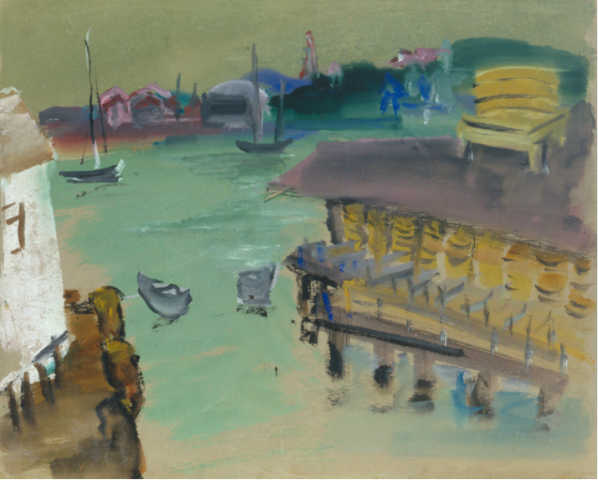
Among the key works in the exhibition is Mark Rothko, Untitled (wharf, Gloucester, Massachusetts), 1934. Collection of Christopher Rothko. It’s a very loose, aqueous rendering with the inventive color that we associate with the master. It has been gifted to the museum where it will be forever treasured as a memory of this remarkable exhibition.