

Bibliomania Plays Film at Linbcoln Center
Award-winning Chronovisor Crowns the Festival
By: Susan Hall - Aug 19, 2026
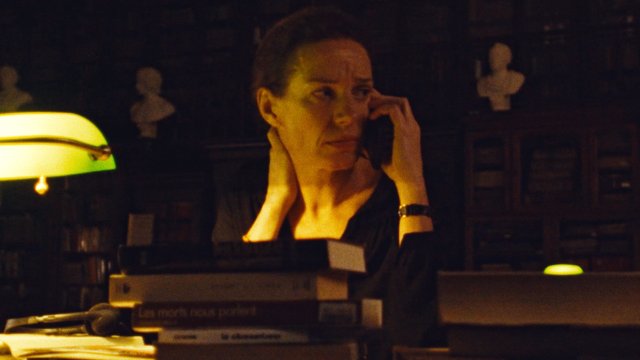
Film at Lincoln Center presents Bibliomania: A Preface to Chronovisor, a 15-film repertory series running from August 28 through September 3, 2026. The festival preludes the release of Kevin Walker and Jack Auen’s thriller Chronovisor with a program exploring cinema centered on the texts stored in reading rooms, research facilities, and libraries.
Previews of Chronovisor draw us into the upside-down world of text on film—text driving film, actually providing images. Absorbed in this beautiful, dark presentation, the 16mm production grips us in mystery. No one in the theater moves. The debate about absorption versus theatricality recedes as we fall for the idea that if you are engrossed in a film, you can make it your own. The young filmmakers Walker and Auen make this notion work. Theatricality is always the filmmaker’s version, not yours.
Chronovisor focuses on Benedictine monk, Pellegrino Ernetti, who claims to have traveled back in time to see the crucifixion of Christ. The chronovisor machine that makes this possible may have been found by a fictional Columbia University scholar of neuroscience and memory, Beatrice Courte played by Anne-Laure Sellier, a real-life professor of behavioral sciences at HEC Paris, blurring the line between fact and fiction.
Professor Courte traipses through the libraries of New York, seeking clues to the location of the machine and any videos that may have been recorded. No spoilers here.
The New York setting is wonderful because our libraries are so special. We get to visit them when they are empty, as the camera follows Professor Courte up ladders and through stacks.
Father Ernetti was a musicologist, and while we don’t hear the music he did, Professor Courte uses his moniker as a student of polyphony to gain access to various characters who knew him (whom we meet on her phone only).
The score is largely Gustav Holst. Holst’s music is characterized by bold rhythms, unconventional time signatures, stark and unusual harmonies, and brilliant orchestral color. Moving from early late-Romantic lushness to a lean, modern style, his work uniquely blends English folk tunes, mysticism, and cosmic scale. On paper, or in the internet ether, this may sound dull, but not one viewer in the audience rustled a paper or left the theater.
The film’s effect is achieved through intense focus, letting the viewers react instead of leading them theatrically. Highlighting a few sentences of text on the pages of beautiful old manuscripts is more exciting than you can imagine.
All is a golden darkness until the possibility of the machine's location is revealed in Portugal, where we come into the light of day.
Visual images move horizontally. Text, by contrast, is vertical, and the tension between the two is palpable.
Most important is the idea of absorption—the antithesis of theatricality. We join Professor Courte and become engrossed in her tasks, entering her world on our own terms.
The act of absorption is exciting and unusual. Of course, long ago William James participated in Ouija sessions with his wife. Here, the film moves, not the Ouija board.
Each of the films in the festival will contribute to our understanding of absorption and its pleasures.