

The Turn of the Screw
Britten's Sinister Opera Based on Henry James's Novella
By: Victor Cordell - Aug 03, 2026
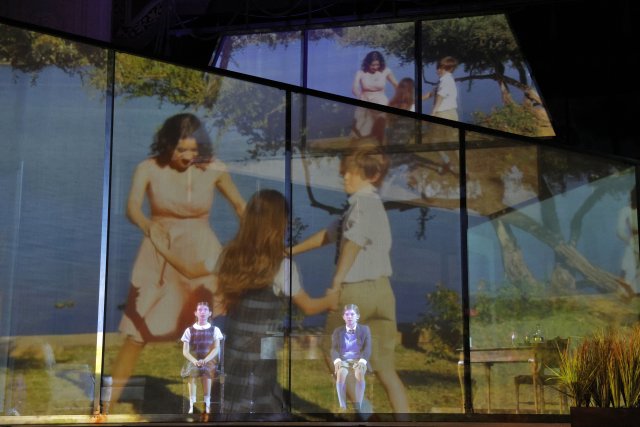
From its opening strains there is no doubt that an ominous tale will follow in the opera version of The Turn of the Screw. The skittish devotees to fright will not be disappointed, and the West Edge Opera version should please aficionados.
Benjamin Britten’s chamber opera with libretto by Myfanwy Piper follows novella author Henry James’s narrative closely. Indeed, in the minds of non-opera buffs, it is a rare opera which equals or exceeds its source material in merit, although Verdi’s Otello is often cited as an exception. With elements of a Gothic novel and ghost story, it tells of an untried governess hired to care for a boy, Miles, and a girl, Flora, on a country estate. Their parents having died, they are wards of an absentee uncle. Two employees who were close to the children, the valet Peter Quint and the previous governess Miss Jessel, have also died.
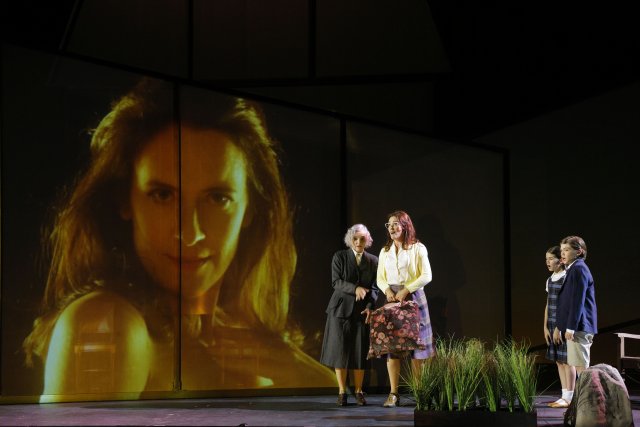
As The Governess, Laura Bohn’s intensity is amplified by being on stage for the full performance, even observing action she’s not involved in. Though a lyric soprano, her voice possesses dramatic edge to convey the deep anxieties of The Governess as she descends from naïve optimism to paranoia.
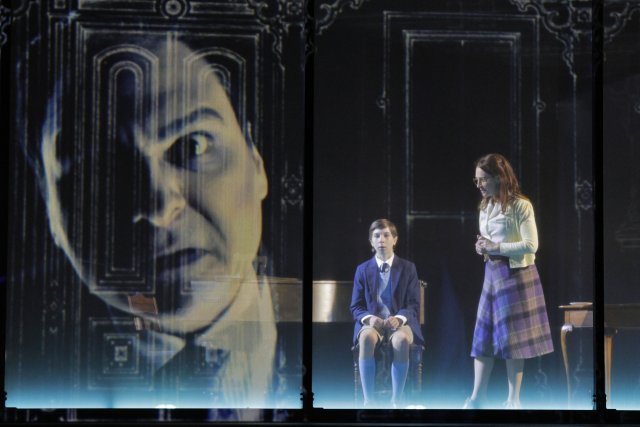
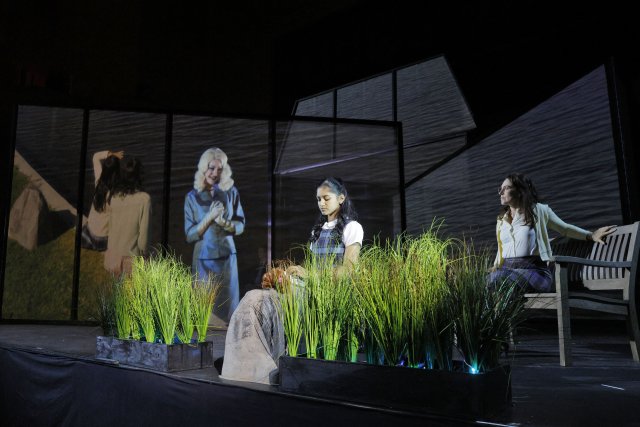
Her vague unrest (“O why, why did I come?”) solidifies having seen, or thinking that she’s seen, the deceased employees. Portrayed by powerful tenor Alex Boyer, Peter Quint is the opera’s male lead, yet his profound visual presence is through projected images. Boyer and smooth soprano Aléxa Sessler as Miss Jessel sing unseen from an upper gallery of the auditorium, with their live images projected onto scrims on the stage. A vocally and visually disemboweled state results that works perfectly to convey their otherworldliness. And particularly, the macabre close ups of Quint make even the fair-faced Boyer look menacing.
Meanwhile, the children, played by Noah Hajduk and Roya Agarwal, become more disturbing with their morbidity. Increasingly, The Governess despairs that they are under the control of Quint and Miss Jessel. Housekeeper Mrs. Grose, played by accomplished veteran soprano Erin Neff, cannot cope, as she acknowledges that she isn’t capable of competing with the bright and devious children.
Britten’s score suits the instability of the haunting story and its characters with a mix of tonal and atonal music. Jonathon Khuner’s orchestra is limited to 13 musicians, but many have solos, often imitating things in nature such as a flute sounding like a bird or a tom-tom drum like an uneasy heartbeat. The general audience will appreciate the music for its inventiveness and foreboding. Even the children singing the ditty Tom, Tom, the Piper’s Son sounds grotesque.
Musicologists will appreciate the score more intellectually. Motifs, especially the portentous 12-note “Screw” theme, which in part draws from Schoenberg’s 12-note atonal technique, appears in altered forms throughout.
The other prominent motif is “Malo,” which is Latin for “I prefer” or as sung by Miles “I would rather be.” It comes from Miles’ language lesson and becomes his theme. Except for diacritical marks, malo is a homophone for other words and has ambiguous interpretation. It expresses innocence (the movie title based on the novella is The Innocents), but it also suggests admission of guilt. Thus, Britten’s diversion from James’s novella makes the story even more ambiguous and interpretable, which many would consider a good thing. Among the ambiguities, is The Governess delusional and seeing things with her vision of the dead, or was she just told that they were dead? Are the children's behaviors just pranks, or are they really evil?
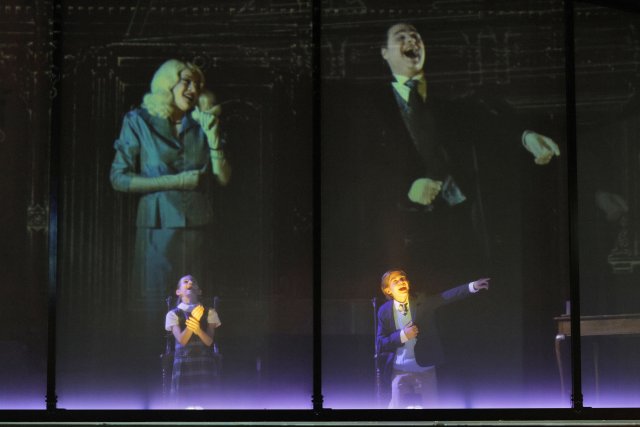
West Edge General Manager Mark Streshinsky directs the impressive production with its inventive use of technology. Set and Projections Designer Yuki Izumihara devises spectacularly spooky staging starting with a black-and-white projection depicting the manor. Two asymmetrical layers of scrims front and rear display most of the projections, creating a space where much of the action takes place. While it could be characterized in many ways, it seems like a prison where this isolated party of four living souls is trapped.
In eerie contrast to the live proceedings, recorded moving images of Quint and the children enjoying activities like tossing balls and playing piano are often projected which have the feel of home movies. Is this to say that superficial representations of how we live can often be misleading?
The Turn of the Screw, composed by Benjamin Britten with libretto by Myfanwy Piper and based on the novella of the same name by Henry James, is produced by West Edge Opera and plays at Scottish Rite Center, 1547 Lakeside Drive, Oakland, CA through August 15, 2026.