

Cabaret
Moving co-production in South Florida
By: Aaron Krause - Jun 25, 2026
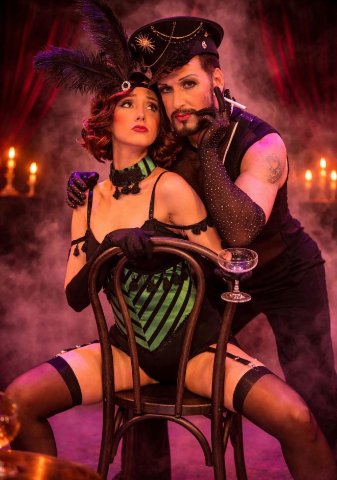
In a current engaging co-production of Cabaret, the audience enters the Kit Kat Klub before the first scene. Once we’re inside the small space, cast members invite us to dance with them onstage and pose for photographs. You don’t have to comply; these are just friendly invitations. While the cast invites us onstage, some performers mingle with patrons in the audience seating area. The Kit Kat Klub and Empire Stage’s intimate theatrical space become one and the same. This blurring of space is also the production’s main idea: entertainment and danger existing side by side, each trying to outlast the other.
Cabaret’s first song, “Willkommen” (German for welcome), opens the show with a warm invitation to the audience. The Emcee lets us know we are meant to leave our troubles outside and enter the Kit Kat Klub’s world of entertainment. He is joyful as he introduces the club’s regular performers and dances with them, establishing the show’s tension between entertainment and warning.
Florida Theatrical Events and Artbuzz Theatrics’ strong co-production runs through June 28 in Empire Stage’s intimate black box space in Ft. Lauderdale. The performance lasts about two-and-a-half hours, including intermission. Larry Buzzeo, ArtBuzz Theatrics Artistic Director, directs and co-stars as the Emcee.
Cabaret, a 1960s Broadway musical that won the Tony Award for Best Musical, takes place during the early 1930s in Berlin, as the Nazi Party rises to power. It is based on the 1951 play I Am a Camera by John Van Druten, which in turn was adapted from Christopher Isherwood’s Goodbye to Berlin, depicting life in the final years of the Weimar Republic.
Cabaret is a concept musical in which thematic ideas take precedence over conventional narrative structure. The show unfolds on two levels: the songs inside the decadent Kit Kat Klub, and the events taking place in the world outside. Inside the club, the Emcee repeatedly insists that life is “beautiful,” even as that outside world grows increasingly unstable.
Much of the story centers on two couples whose relationships come under strain as the Nazis’ power expands. Fräulein Schneider’s song “So What?” reflects her resigned, pragmatic outlook, and its refrain —“So who cares, so what?”—quietly foreshadows the moral indifference the show ultimately critiques.
Before the first scene, we hear sound effects that suggest a physical fight. Glass smashes. Nazi dictator Adolf Hitler’s shouting voice reverberates, and we hear what resembles a loud beating heart. Then the lights come up to reveal a smiling, red lipstick-sporting Emcee. He winks at us, enthusiastically asks if we’re feeling good, and, in a carefree and seductive voice, tells us to leave our troubles outside because inside it’s “beautiful.”
The juxtaposition between the unsettling sound effects and the Emcee’s laid-back demeanor once the lights come up suggests the co-production’s central tension: a party-style atmosphere competing with warning signs of danger, as entertainment tries to divert attention from them.
Many actors, including Joel Grey and Alan Cumming, have put their own stamp on the iconic, enigmatic role of the Emcee. Grey’s portrayal presented an aloof, sexless, and clownish outsider, while Cumming embodied a more hyper-sexualized, gritty figure deeply immersed in the club’s decadence. Buzzeo creates a more convivial, almost seductive Emcee — he’s less predator, more host, which makes the darker turns more unsettling.
Fortunately, Buzzeo’s Emcee is not one-dimensional. He may wink, smile at us, and pose in a sexy manner, but he turns briefly menacing at key moments. In this co-production, for example, a pleasant woman’s voice sings the first part of Kander and Ebb’s pseudo-Nazi anthem Tomorrow Belongs to Me, which emulates actual German folk songs. It is serene and ingratiating, but the later section becomes chilling as the singers grow more forceful and authoritarian. In a lower, more menacing voice, Buzzeo’s Emcee sings the final two words “to me,” underscoring the darker turn of the moment.
Another song that comes early in the show is “Don’t Tell Mama,” performed by British regular club entertainer Sally Bowles. In the number, Bowles reveals the cheeky realities of her life as a Kit Kat Klub performer. Her rebellious, free-spirited personality comes alive here, and Alexandra Van Hasselt sings it with the right amount of playfulness and excitement, like someone letting us in on a secret.
Van Hasselt’s Bowles is generally high-energy, and she seems fully invested in the hectic life of a cabaret entertainer. She is in near constant motion, seemingly oblivious to the realities of life outside the club. When the word “politics” comes up, she wonders, “What does that have to do with us?” as though it exists outside her world entirely. Van Hasselt’s Bowles is eager and engaged as long as what’s in front of her fits within her immediate sphere. She is flirtatious and shares strong chemistry with Chad Raven, who portrays visiting American writer Clifford Bradshaw, in Berlin in search of material for a novel. But when difficulties arise, she pulls away and retreats, like an eye-rolling, rebellious teenager who wants nothing to do with responsibility. Her cheerful rendition of the title song suggests she is trying to convince herself and others to "come to the Cabaret" despite the increasingly troubling reality surrounding her.
The dark-haired Raven, clean-shaven and fresh-faced as Bradshaw, arrives in Germany at the top of the show eager and friendly. He carries a pure, unassuming aura, like someone ready for a fresh start or new beginning. He not only speaks with interest, but listens and observes with believable curiosity. He is also a gentleman, at one point kissing the hand of Fraulein Schneider (Elissa D. Solomon).
On the surface, Raven’s Bradshaw seems calm and in control. But cracks in that façade appear during tense moments. His voice grows louder and his expression more serious as he deals with Bowles’ irresponsibility and the growing tensions outside the Kit Kat Klub. He chides Bowles, urging her to awaken to the realities right in front of her, and physically struggles with Ernst Ludwig, resulting in a black eye. The blackened eye serves as a visible mark of the world intruding on his earlier innocence. By the end, he is fully awakened to the realities of the time but believes he should have recognized them earlier. “We were both fast asleep,” he says in wonder at the end, referring to himself and Bowles.
Bradshaw and Bowles comprise one of two couples in Cabaret, and both relationships receive substantial dramatic weight rather than one serving as a primary couple and the other as comic relief.
In addition to Bradshaw and Bowles, Schneider, a boarding house landlord, and Schultz, a fruit seller, look forward to getting married. However, the Nazis’ growing power threatens to at least postpone their nuptials.
This co-production marks Solomon’s second time portraying Schneider (she also performed the role at the now-defunct Broward Stage Door 11 years ago). We meet Schneider early on when she negotiates with Bradshaw for his stay at her boarding house. In “So What,” Schneider establishes her resilience and her ability to adapt to adversity without letting it overwhelm her. Solomon’s Schneider sings the song with firmness and a carefree aura, suggesting a survivor who takes things in stride.
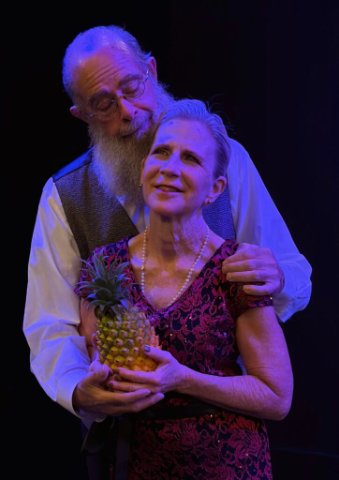
She shifts from that steadiness to pleasant surprise in the romantic and humorous “It Couldn’t Please Me More (A Pineapple),” when her suitor presents her with an unexpected gift. It is a sweetly moving duet, with Solomon and Michael Small, as Herr Schultz, demonstrating touching chemistry as they dance and sway to the dreamy, waltz-like music.
The tone turns more defensive in “What Would You Do,” as Schneider sings about the agonizing moral dilemma of surviving in a society where a dangerous regime is rising. We hear the intensity in Solomon’s voice as her character considers her future with Schultz. The fact that he is Jewish places both of them at risk if they were to marry.
With a long, grey beard, wide, excited blue eyes as well as contagious and convincing passion, Small brings Schultz to believable life. He imbues his character with tenderness and unmistakable fervency that underscores his sincerity. Small’s Schultz is also self-assured – so much so that he insists, with adamancy, that Nazism will pass and he’s not in danger because he’s just as German as anybody else. "It is nothing! Children... mischievous children on their way to school. They did not even know it was my shop,” he says worry-free after we hear glass at his business shatter.
Charles Page deftly portrays Ernst Ludwig, who greets Bradshaw upon his arrival in Germany and appears throughout the story. Page charts Ludwig’s shift from charm and warmth to open hostility after learning that Schultz is Jewish. During the performance, the audience audibly gasped at the sight of the swastika on Ludwig’s sleeve.
Throughout Cabaret, librettist Joe Masteroff toggles between the brutal outside world and the carefree existence inside the Kit Kat Klub. Within the establishment, the Emcee and others use songs and banter to mock the rising fascism, political turmoil, and antisemitism tearing through the “real world” outside. The persistent party atmosphere suggests how we turn to escapism to shut out each burst of bad news—until we no longer can.
Lighting designer Preston Bircher effectively employs hues such as red and green to enhance atmosphere and mood. For instance, green lighting bathes the stage during “Money,” which receives a playful rendition here, with characters repeatedly emphasizing the word “money” as though obsessed. In other scenes, red lighting suggests danger and passion. One surprising exception comes during the dark number “What Would You Do?” when the stage remains brightly lit. Dimmer lighting might have better complemented the song’s agonizing moral conflict and somber tone.
A few performance and production choices slightly weaken the overall effect. While Van Hasselt is convincing as the flighty Bowles, her British accent needs work, and the actors portraying German characters could also improve their accents. Overall, however, this co-production of Cabaret offers a timely and cautionary message about the dangers of ignoring warning signs until it is too late. Practically 60 years after its Broadway debut, Cabaret still lands with uncomfortable clarity: the danger is not the club itself — it’s how easily we’re willing to inhabit our own Kit Kat Klubs.
Cabaret runs through Sunday, June 28 at Empire Stage, 1140 N. Flagler Drive, Ft. Lauderdale (two blocks north of Sunrise, east of the railroad tracks); Thursday, Fridays and Saturdays at 8 p.m.; Sundays at 5 p.m. General admission tickets are $45. For more information, visit www.empirestage.com or call (954) 678-1496.