

Nike: Form Follows Motion,
Museum of Arts and Design
By: MAD - Jun 11, 2026
Nike: Form Follows Motion
Museum of Arts and Design | New York City
September 12, 2026–March 7, 2027
This fall, the Museum of Arts and Design (MAD) presents Nike: Form Follows Motion, marking the U.S. premiere of the first ever comprehensive museum exhibition on the world’s most influential sports brand. Originated by Germany’s Vitra Design Museum and curated by New York- and London-based curator, author, and historian Glenn Adamson, the exhibition traces the five decades that turned a small Oregon running company into a global cultural force. The exhibition emphasizes the importance of sports as an arena for design innovation and global change. Following iconic sports moments in the New York City area, from the New York Knicks’ historic 2026 NBA Finals run, to the FIFA World Cup 2026™ and the 2026 U.S. Open, Nike: Form Follows Motion will be on view at MAD from September 12, 2026, through March 7, 2027.
Drawn primarily from the Department of Nike Archives (DNA), a collection of more than 200,000 objects never before accessible to the public in this depth, the exhibition assembles experimental prototypes, original design studies, rarities, and one-offs alongside the icons—the Waffle Trainer, the Air Force 1, the Air Jordan, the Air Max, Flyknit, and the Vaporfly.
“Through many exhibitions past and recent, MAD has spent decades showing that the objects closest to our bodies—the things we wear, hold, and use—are where craftsmanship and design do their most meaningful work,” said Tim Rodgers, MAD's Nannette L. Laitman Director. “This exhibition brilliantly emphasizes the importance of sports as an arena for profound design innovation and global change. From Nike’s early kitchen experiments of the 1960s to the advanced science of the Nike Sport Research Lab, we see how pushing the limits of the human body reshaped our entire visual culture. This isn’t just a story about sportswear; it’s about how design absorbs the moment and shifts society. New York City is the epicenter of that cultural impact, making it the perfect place to present these legendary artifacts to the American public for the very first time.”
Nike: Form Follows Motion unfolds across four chronological sections.
Track begins with Nike’s origins in the 1960s and the company’s founding by Phil Knight, who had been a runner in college, and his former coach Bill Bowerman. Visitors encounter early Bowerman experiments that created the first Waffle Sole in his kitchen, founding-era artifacts, and the story of the Tennessee State University Tigerbelles, a track team of Black women dominant during the civil rights era in the U.S.
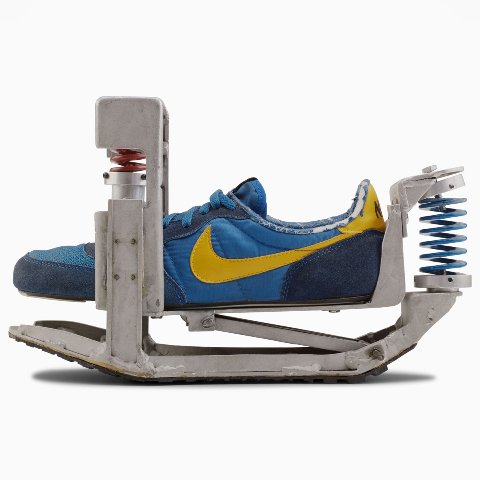
Air moves into the 1980s, when Nike vaulted from running specialist to cultural force. The section centers on the invention of the visible Air sole, introduced in the 1987 Air Max, and includes engineer Frank Rudy’s original testing machine alongside air-bag prototypes that reveal how a sealed capsule of pressurized gas became a design icon you could see through a window in the side of a shoe. The section also traces Nike’s foray into basketball, tennis, global football, and skateboarding, and the partnerships with athletes, including Michael Jordan, Serena Williams, and LeBron James, that turned product into mythology.
Sensation opens the doors of the Nike Sport Research Lab, one of the world’s most advanced facilities for studying the body in motion. Here the exhibition examines the science behind Nike Free, the Vaporfly and the sub-two-hour marathon, and the material breakthroughs, Flyknit chief among them, that have reshaped both performance and the conversation about sustainability in footwear. The section closes on Nike’s ongoing work in circular manufacturing, ethical sourcing, and recycled materials.
Relation is the exhibition’s culmination, charting how a sports brand became a global cultural phenomenon. The gallery showcases fifty examples of groundbreaking footwear born from high-profile artistic partnerships and community-driven projects. By explicitly focusing on Nike’s impact on popular culture and counterculture, the section sheds light on the public’s almost mythical devotion to sneaker culture. Surrounded by music videos and social media artifacts, visitors will see how Nike drew inspiration from global subcultures to become a prime mover of street style. Ultimately, this space illustrates how sport and design combined to push societal boundaries, fundamentally reshaping how we express identity, diversity, equality, and human possibility.
Throughout, the exhibition foregrounds the legendary designers themselves—Diane Katz, Tinker Hatfield, Eric Avar, and others working inside the company—alongside the external collaborators and the athletes whose feedback has, since the beginning, been treated at Nike as the first principle of design.
The exhibition at MAD will be extended through a robust slate of public programs, including: a conversation between exhibition curator Glenn Adamson and Nike’s Nicholas Schonberger, Senior Director, Corporate Narrative (Sept. 19); a conversation co-hosted with AIGA NY on the topic of sports and design culture; adult workshops inspired by artists working at the intersection of sports and design; monthly sneaker care and customization workshops led by Devonn Vidal, Founder and CEO of Sneakky Klean; drop-in art-making activities on select Thursday nights, and more. The programming schedule and information will be announced on the Museum’s website (madmuseum.org) in the coming months.
Nike: Form Follows Motion is accompanied by a major 356-page publication featuring essays by scholars Sam Grawe, Adam Bradley, William Myers, Jared Dalcourt and Ligaya Salazar. Illustrated with nearly 300 historic and contemporary images, the book will be available for purchase from The Store at MAD, alongside a selection of exclusive exhibition merchandise.
For tickets and information, visit madmuseum.org.
Nike: Form Follows Motion is organized by Vitra Design Museum, Weil am Rhein, Germany, and is curated by Glenn Adamson and assistant curator Marcella Hanika with exhibition design by JA Projects and graphic design by Daniel Streat, Visual Fields.
The exhibition is made possible by the New York State Council on the Arts with the support of the Office of the Governor and the New York State Legislature, and is supported, in part, by public funds from the New York City Department of Cultural Affairs in partnership with the City Council.
The Museum of Arts and Design (MAD) champions contemporary makers across creative fields and presents the work of artists, designers, and artisans who apply the highest level of ingenuity and skill. Since the Museum’s founding in 1956 by philanthropist and visionary Aileen Osborn Webb, MAD has celebrated all facets of making and the creative processes by which materials are transformed, from traditional techniques to cutting-edge technologies. Today, the Museum’s curatorial program builds upon a rich history of exhibitions that emphasize a cross-disciplinary approach to art and design and reveals the workmanship behind the objects and environments that shape our everyday lives. MAD provides an international platform for practitioners who are influencing the direction of cultural production and driving twenty-first century innovation and fosters a participatory setting for visitors to have direct encounters with skilled making and compelling works of art and design. For more information, visit madmuseum.org.