

Stephen Hannock’s Phosphorescent Paintings
Then and Now Spanning Four Decades
By: Charles Giuliano - May 30, 2026
For Berkshire based artist, Stephen Hannock, what’s old is new again.
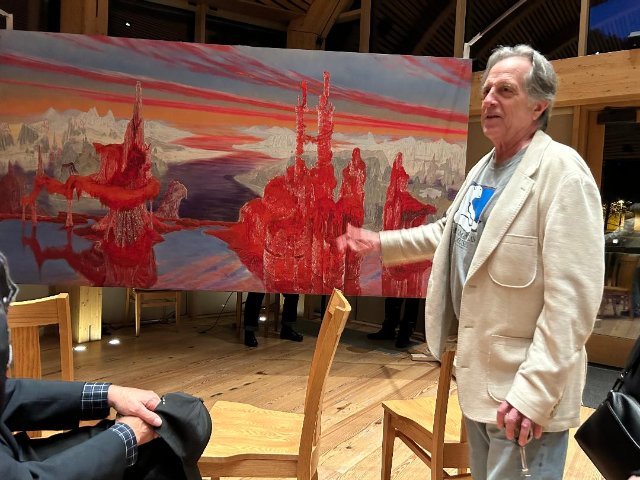
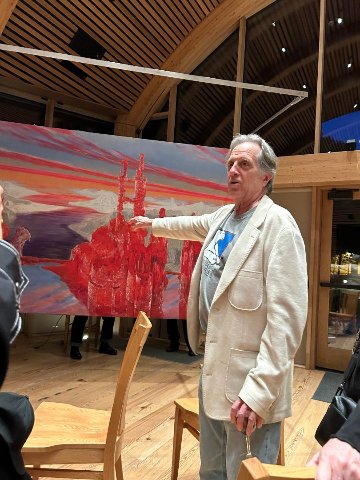
As a youngster in the 1970s, he’s now 75, Hannock boldly experimented with glow in the dark phosphorescent paint. Last night, during a private viewing at Porches, he told me that, back in the day, he had shown the work at night on Boston’s Esplanade, as well as at Williams College Art Museum.
“I was the youngest artist ever to be given a one man show there,” he told the invited guests. He has now completed two of four intended works. One is an original which has been literally been kept in the dark all these years. Another will be a resurfaced vintage work which was cooked by prolonged exposure to light. The fourth will be a new composition in the manner of the Hudson River landscape we viewed for the first time on this special occasion.
Like a rolling stone, in every sense, the artist gathers no moss. It is typical of him to revisit early experimental work now upgraded with boundless insight and energy.
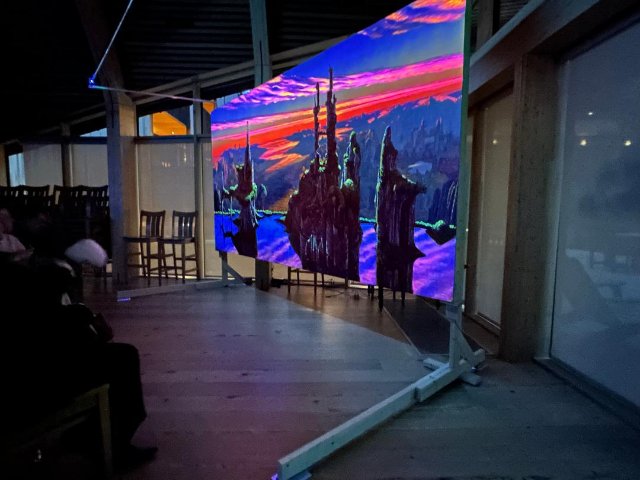
In natural or white light the works are benign and unevocative. But under UV light they come to life with eye popping and sensory snapping vibrant intensity.
Phosphorescent paint is commonly called "glow-in-the-dark" paint. It is made from phosphors such as silver-activated zinc sulfide or doped strontium aluminate, and typically glows a pale green to greenish-blue color.
Standing before the vintage painting it appears rather amorphous and even clunky. I asked if he had just glommed on the paint to create amorphous forms. Au contraire mon frere he responded with a bit of edge. Even back then the work was created subsequent to many studies. Under black light it comes alive with biomorphic, monolithic forms like a psychedelic Stonehenge. There is also an eerie streaky sky.
Looking at the recent companion work on the other side of the space, with a wink and twinkle, he stated that he paints better now than he did back then. It is generally true of representational artists that it takes a lifetime to master their craft.
A case in point is a 30’ panorama of Niagra Falls which has been in the works for decades. It is soon to be featured at a Norman Rockwell Museum show that opens in June. Directors past and present were on hand last night.
Laurie Norton Moffatt was the founding director of the museum some four decades ago. She retires in August replaced by Graham C. Boettcher, Ph.D. following 20 years as director of the Birmingham Museum of Art. Under his leadership, the BMA experienced sustained institutional growth, including the endowment of key positions, the gift of major new collections, and national recognition for innovative exhibitions, digital initiatives, and community-centered programming.
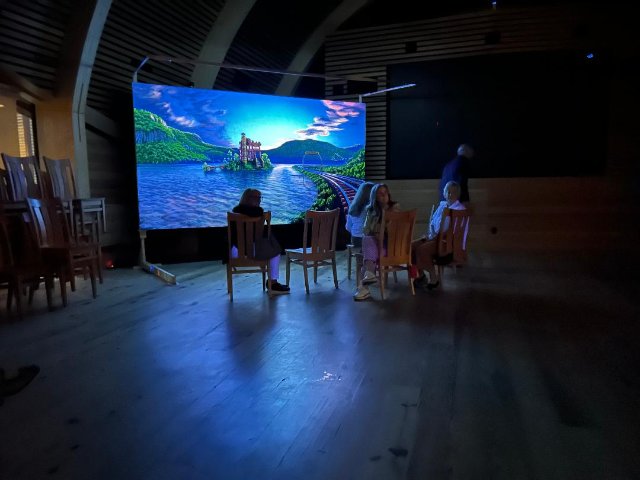
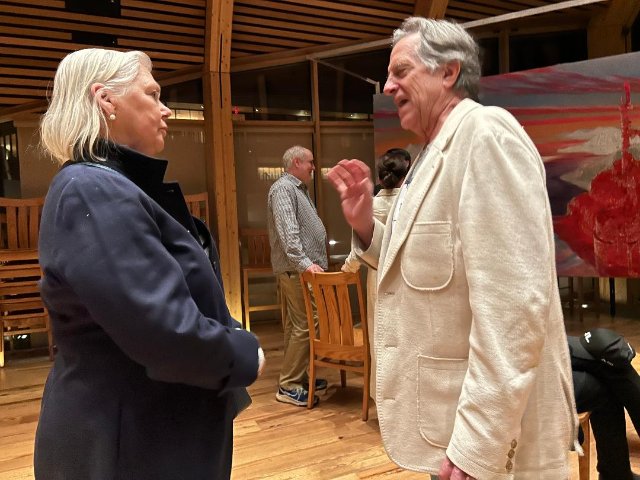
As guests mingled we waited until the space was sufficiently dark. Hannock acknowledged the many that assist him and made this special event possible. Referring to the new piece he compared it to establishing shots particularly those in films by Alfred Hitchcock.
“It puts you into the place and mood for the story he is about to tell,” he said. “In this case you are invited to create your own narratives.”
This is a departure from his signature approach of embedding narrative into his paintings. Standing close to the work one may read the paintings which greatly enriches the experience of viewing them.
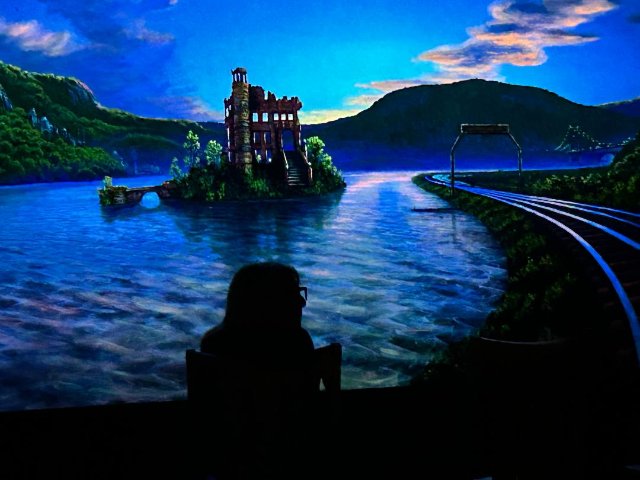
The new painting renders a view along the Hudson River. There is a romantic ruin, in the manner of Thomas Cole, surrounded by water. The luminescence enlivens a pattern of waves. On the right side of the winding shore we note railroad tracks that curve around to a vanishing point. Truly, I have never before seen anything like this.
It is, however, an intermittent experience. In this instance it was an orchestrated event with an evocative sound track. At the apogee of which black light kicked in for a carefully calibrated interval. The material is notoriously fugitive.
I asked him if there had been change and progress with material since he first used it decades ago.
That is certainly the case as he discussed the process. “A jar of the base which comes from Japan weighs as much as a bowling ball,” he said. “It is dense with molecules.” This is mixed with color to apply to the surface.
He calculates that it will take a couple of years to create a new work and then restore the vintage one. Between now and then there will be updates. Typically, the artist works on several projects simultaneously including, currently, a new book on his work as well as a series of silkscreen prints. It’s a lot to keep up with.