

Heartbeat Opera Punches Up Vanessa
Samuel Barber's Opera in Shadowy Chamber Form
By: Susan Hall - May 18, 2026
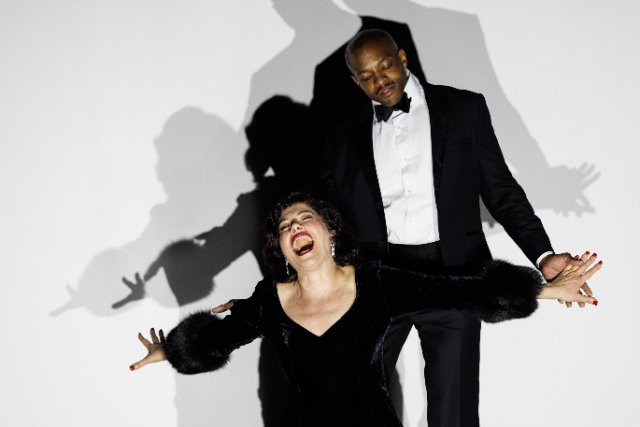
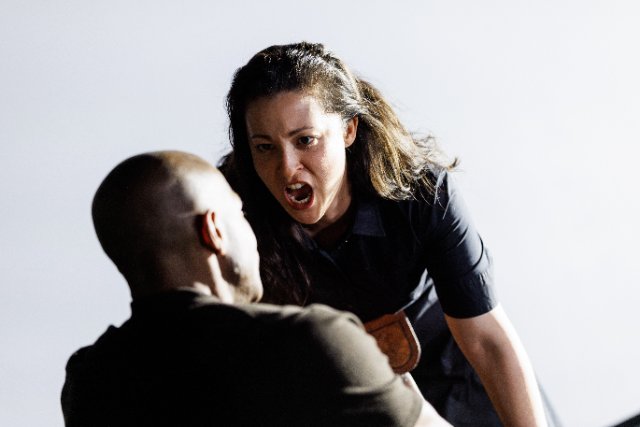
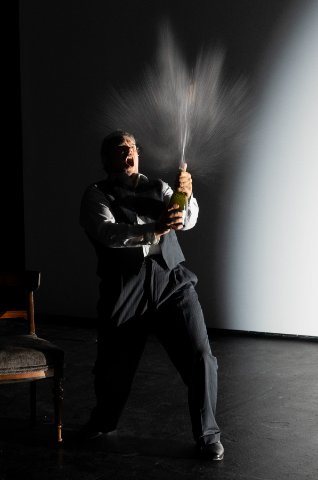
Samuel Barber’s Vanessa is playing at the Baruch Performing Arts Center after a smashing run at the Williamstown Theatre Festival last summer. R. B. Schlather, also of Hudson Hall, directs: Hot sex in a cold clime.
This story was originally told in veils and mirrors, which have been translated into shadows by Heartbeat Opera. A long vertical white wall at the back of the stage captures the singing actors’ gestures and manifests and diminishes their figures depending on the emotional moment being enacted. It is a remarkable visual accompaniment to the pain of romance and the glorious music. A story quite the opposite of black and white is told in black and white to riveting effect.
Five characters move across the stage, real and in shadow. The singing reflects the just-right choices of set and music. Inna Dukach as Vanessa has a rich soprano; Kelsey Lauritano as Erika lets her hair down and her voice expand. Mary Phillips as the Baroness is commanding.
The opera had its world premiere at the old Metropolitan Opera House in 1958. For a long time it languished. Vanessa was famously veiled in the premiere. Now a strand of pearls symbolizes waiting.
Women of three generations represent the librettist’s versions of romantic love as it develops. At first it is romantic; then it becomes more “real,” more “of the world.” Vanessa will depart for Paris not with her lover, but with his somewhat unsatisfactory yet sexy son, Anatol. You absolutely want Frederick Ballentine in this role. Yet we know there may not “always be Paris” if Vanessa’s money runs out. She is merging into the real world.
Erika, her niece, who falls for Anatol too, is a romantic innocent, though not a simple one. How she will wind up after her own wait is a big question mark. The Baroness, Erika’s grandmother, is very much of this world. The question that haunts the opera is whether all three women represent one person in varying stages of development, or are in fact entirely different.
No question that librettist Gian Carlo Menotti was writing about his own relationship with Barber, an incurable romantic to Menotti’s worldliness and practicality. Sometimes Barber’s music seems to plead with the story to turn out well—to be romantic. The score is often beautiful. Famous arias and ensembles have become staples of concert literature.
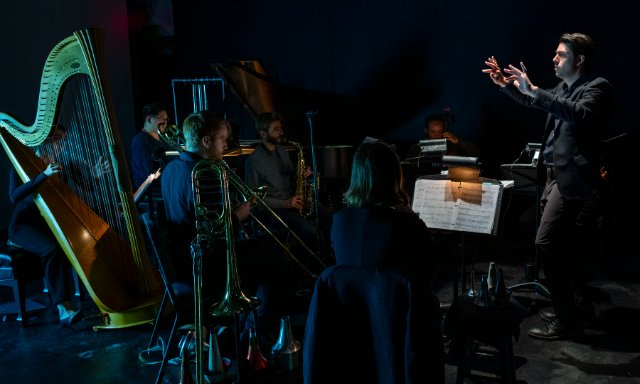
Dan Schlosberg compressed the score for chamber orchestra. In the reduced version, trombonist Sam George was responsible for parts originally written for ten orchestral instruments. Among the many sounds he produced was a lovely, songlike quality we do not usually associate with the trombone. The semi-dissonant musical punctuation marks that helped make the original score so exciting are crisp and compelling in the chamber version.
Jacob Ashworth, who conducted, also shaped the libretto to fit a one-act, 100-minute time slot. With Vanessa, he was not dealing with long-dead librettists and composers. G. Schirmer, representing the opera, was warm to the idea of Heartbeat, which has developed a glowing reputation since its founding in 2013. (In fact, one of the founders, Louise Proske, is directing Lise Davidsen in Macbeth to open the Metropolitan Opera’s 2026–27 fall season.)
While Barber was not as specific about manipulations of the score, Menotti was about his words. Ashworth was allowed to cut, but not to create new language. He says he worked with “a surgeon’s skill.” It all comes together magically.
Playing thrugh May 3. Tickets here.