

The Crucible
Palm Beach Dramaworks' Powerful Professional Production
By: Aaron Krause - Apr 06, 2026
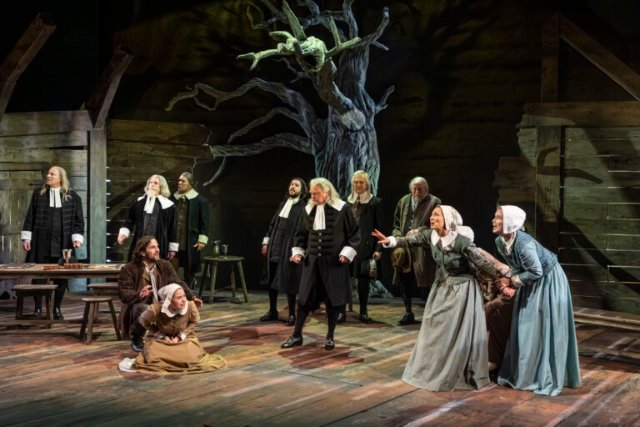
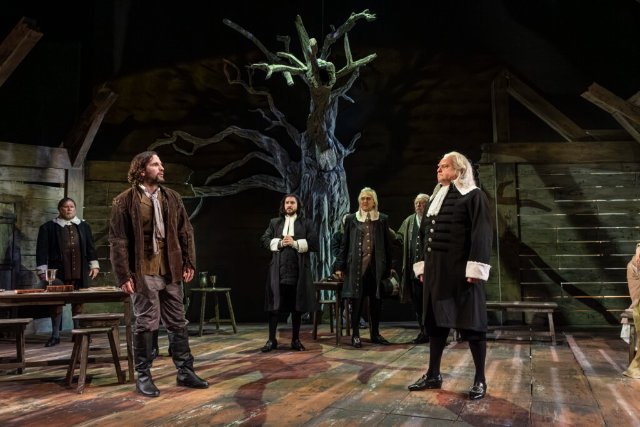
At the end of Palm Beach Dramaworks’ (PBD) spellbinding professional production of Arthur Miller’s The Crucible, a drumbeat and the ominous clang of a bell reverberate. The actors silently face upstage, where numerous names materialize on a projection screen. The moment is dread-filled, and PBD Producing Artistic Director Bill Hayes’ large, skilled cast handles it with care. The scene pays homage to the victims of one of America’s darkest periods, the Salem Witch Trials (February 1692–May 1693), without resorting to melodrama.
From the first clap of thunder to the final tolling of a clock-like bell, PBD’s production, running through April 19 in the company’s intimate West Palm Beach space, rivets us. It seizes our attention and rarely lets up during its roughly three-hour runtime (including intermission), keeping the tension taut until we leave devastated and deep in thought.
The Crucible, a Tony-Award winning classic historical drama, is also a cautionary tale set in 1692 Salem, Massachusetts. The play explores the anarchy and moral panic that seizes a small Puritan community as accusations of witchcraft spiral out of control. Central figures include John Proctor, a farmer whose hushed sins become fodder for teenager Abigail Williams’ manipulations; Reverend Samuel Parris, the town’s paranoid minister; and the rigid court officials within this theocracy who hand down the ultimate penalty of hanging “witches” who don’t confess to witchcraft. The play’s title is fitting—lives, reputations, and consciences face the ultimate test (the titular “Crucible”) as fear, accusations, and hysteria supplant reason. The play honestly depicts the Salem Witch Trials but isn’t a historical document; Miller altered certain facts for dramatic effect.
The play is a well-known allegory for McCarthyism (named after Sen. Joseph McCarthy’s accusations) and the Red Scare in 1950s America—a more modern-day “witch hunt” that sought to identify and penalize Communists or Communist sympathizers. Miller, one of the many accused sympathizers, used the 1692 Salem Witch Trials to parallel the paranoia, mass hysteria, and blacklisting of suspected Communists. The late, great playwright (1915–2005) sought to show how fear can cause a society to turn on itself. In the end, the play leaves us to ponder our own crucibles and other modern instances when fear, finger pointing, and hysteria trumped calm and reason.
PBD’s production grips us with a foreboding sense from the moment we walk into the theater. We instantly witness designer Roger Arnold’s vivid sound effects such as a howling wind, flashes of lightning, thunderclaps, and mysterious figures briefly appearing on projection screens (projection designer Adam J. Thompson). The real storm these effects evoke symbolizes the metaphorical storm of hysteria and accusations soon to sweep through Salem. A chill runs through the audience, hinting at the unsettling events to come. Of all the minimal set pieces onstage (designer Doug Wilkinson), a large, leafless tree grabs our attention, its branches jutting toward the audience as if implicating us in the drama about to unfold.
The actors silently come onstage as disquieting sounds and music fill the air. Smoke or fog gathers as several performers move in ritualistic dances to drumbeats, culminating in a human scream. Then, in stark contrast to the pandemonium, we hear sounds resembling farm animals, subtly reinforcing Salem’s rural character at the time.
We see 9-year-old Betty Parris (young performer Kaia Davis) lying still as her father, Reverend Samuel Parris (Tom Wahl), paces in worry. As more characters enter the space, we sense unease—but not outright panic just yet. Betty remains in a trance-like state after dancing in the woods with other girls and the Parris family’s slave, Tituba (Karen Stephens). A medical doctor (an offstage character) examines Betty and finds nothing physically wrong with the girl. With no medical diagnosis apparent, the townspeople summon Reverend John Hale (Nick Jordan), an expert on witchcraft, to investigate. With longish dark hair and sporting a grey period outfit (costume designer Brian O’Keefe), Jordan’s Hale confidently enters the scene with an air of authority and eagerness, but not arrogance. He kneels, gently examining Betty for signs of the Devil, and tenderly speaks to her. He assumes the manner of a respected physician demonstrating sincere concern for an ill child. His voice carries urgency as he addresses the adults. “Stand close in case she flies,” Hale instructs. Jordan recites the line with complete sincerity, highlighting the situation’s absurdity.
Jordan’s Hale is similarly tender with Tituba when the others suspect she may have bewitched the girls. He kneels to meet her at eye level while she remains on the floor, sympathetically coaxing information from her. Stephens’ Tituba speaks with evident anxiety, trying to persuade Hale and the others that she is a good Christian woman who would never harm the village’s children. “Bless the Lord!” Stephens’ Tituba desperately exclaims, making us feel for this poor woman under suspicion. However, her master threatens to whip her to death if she doesn’t confess to witchcraft. When she mentions names, the scene erupts into one of the production’s first frenzied moments, as everyone begins loudly naming names at once.
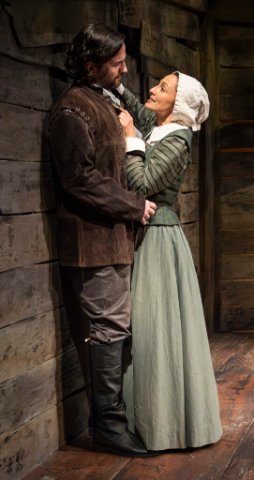
Under Hayes’ careful direction, the production succeeds at contrasting chaotic moments with quieter scenes brimming with understated tension. One such scene plays out in John and Elizabeth Proctor’s home following the eruption. The couple quietly speak to each other, but they’re physically apart and don’t always make eye contact, emphasizing the tension between them. Tom Patterson as John Proctor, and Julie Kleiner as his wife, Elizabeth, subtly convey upstanding but unassuming characters who are living through a trying time. This scene’s early moments are like the calm before the storm. The “tempest” invades the space as Hale and authorities from the court arrive to question the Proctors about their actions. At this point, Jordan’s Hale assumes a demeanor that’s still civil, but it’s more accusatory than when he addressed Betty and Tituba. At one point, Hale asks John to recite the ten commandments, and he names them all except the sin against committing adultery (John had an affair with the family’s former servant, Abigail Williams (Elisabeth Yancey)). While John doesn’t mention the prohibition against committing adultery, Elizabeth chimes in with that commandment. "You see, sir, between the two of us, we do know them all," John tells Hale, a line that elicits nervous laughter.
With longish dark hair, mustache, and beard, Patterson’s John Proctor resembles the quintessential everyman that Miller identified as an apt subject for tragedy; his quietly determined expression reinforces that impression. He speaks in a low-pitched voice that betrays conviction, his tone measured and resolute. But when Patterson’s Proctor senses danger or injustice, he moves as urgently as a startled cat, and his voice rises markedly in volume. At least once, he grabs servant Mary Warren (Cat Boynton) by the arm and throws her to the floor. He grows testy with his wife by coldly referring to her as “woman.” If that makes Proctor seem insensitive, such references were typical of the period’s patriarchal system, in which women were largely subservient. Such treatment may at least partially account for the tension and hysteria that erupt as the play progresses.
Sexual tension is evident between John and Abigail Williams during a scene that takes place between them in the woods. Many modern stage productions omit this scene, and Miller himself eventually removed it because he felt it disrupted the play’s driving tempo. While some directors and critics have argued that the scene slows the story’s momentum, PBD’s production includes it, and its quiet nature provides a brief reprieve from the play’s intensity as it ramps toward the finale. The scene also offers a glimpse into John and Abigail’s relationship. Abigail tries to seduce John, but he initially rejects her, insisting he is devoted to his wife and threatening to reveal their affair to the court if she continues her accusations. She approaches him and attempts to touch him, but he moves away; eventually, she runs into his arms, and they hug.
As Yancey deftly portrays her, Williams is believably assertive during key scenes, but there are moments when she seems more subservient. However, even when she is more passive, Yancey’s Williams can be manipulative, making it difficult to tell when she is feigning emotion and when she is sincere. In court, wide-eyed and sharp-voiced, she manipulates the system by pretending Mary Warren’s spirit has taken the form of a yellow bird perched on the rafters. There is genuine panic in her voice as she begs “Mary” to stop tormenting her. But in the process, Williams and the other girls distress Warren by echoing all of her pleas. The scene is intense, darkly funny, and even thrilling. Significantly, the performers wisely play these moments with absolute sincerity, which enhances the humor.
Dark humor also colors performances such as Andy Prosky’s severe, unbending, and pompous portrayal of Deputy Governor Danforth, one of the court’s chief officials. With an intensity that recalls Inspector Javert in Les Misérables, Prosky’s face appears to redden as he maintains his firm belief that he is doing the right thing by rooting out witches. With a rigid posture and consistently stern voice, Prosky’s Danforth makes it clear that he is not playing games with anyone. He also unapologetically insults Rev. Parris when he remarks, “Mr. Parris, you are a brainless man.”
In his script, Miller wrote that Parris “cut a villainous path, and there is very little good to be said for him.” As the beleaguered pastor, Wahl does not create an outright villain, but rather a self-centered man who is often paranoid. He speaks convincingly in defensive tones, and anxiety creeps into his voice, which rises in pitch with concern.
Wahl is part of a strong supporting cast of performers who inject their characters with impressive realism. Their movement consistently seems unforced and purposeful, and they mostly speak with clarity and conviction. However, because they speak with an accent somewhere between British and Irish (the Puritans originated in England during the late 16th century), some words can be difficult to understand.
But the cast clearly delivers key words and phrases that illuminate character and theme. At the climactic moment, John Proctor appears in chains, his clothes and face muddied. As weary as he may feel, Patterson’s Proctor seems to gain a second wind, pouring his soul into the words. While he does not cry, his passion is unmistakable as he chooses death over sullying his good name. Meanwhile, Kleiner’s Elizabeth sounds at peace with her husband’s decision: “He have his goodness now. God forbid I take it from him.” While “he has” would be grammatically correct in modern English, Miller wrote the dialogue in a stylized, archaic dialect to reflect 17th-century Puritan Salem.
At the end, the final bell tolls and the names of the accused appear on the projection screen. A sense of dread overtakes us and we feel devastated. But we leave the theater with a renewed sense of urgency to encourage others to experience Miller’s poetic, cautionary tale, showcasing his skill in crafting tension and moral insight. In this timely and timeless piece, he reminds us of the dangers of unchecked power, hysteria, and vindictiveness. In today’s divisive world, these are lessons we can all take to heart.