

Director Melia Bensussen’s approach to Arthur Miller’s classic American tragedy, A Death of a Salesman, was a brave move that does not totally succeed. Bensussen has stated that three things influenced her approach: Miller’s original title of the play, The Inside of His Head; his original stage direction, which does not mention a set but refers to Willy opening “an invisible door”; and the fact that Willy Loman is Jewish in a world run by Christians.
Those who have never seen this classic play will probably come away from the Hartford Stage production moved and certainly understanding why it has endured. But they may not truly appreciate how great a play it is.
This is a production with both major strengths and some major weaknesses. Certainly, the sound design by Darron L. West, who also composed music, is a strength in the production. He refers to it as “coming up with a fiction that supports the action.” Before the show starts and during intermission, we hear recordings of popular songs from the 1940s and ‘50s with lyrics about dreams, including “Wrap Your Troubles in Dreams,” “I Had the Craziest Dream,” and “You Only Hurt the One You Love.” While enjoyable, the selections try to drive home the point too obviously.
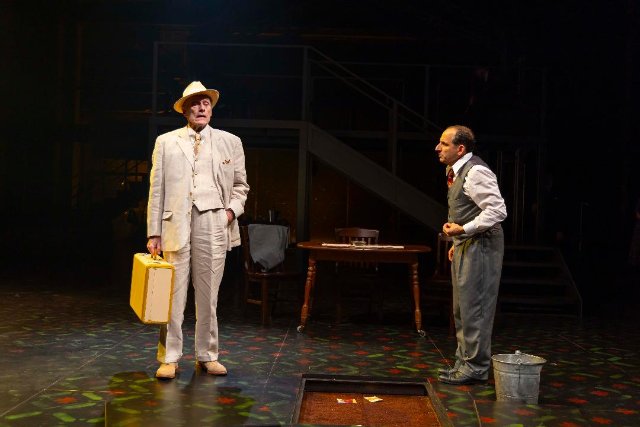
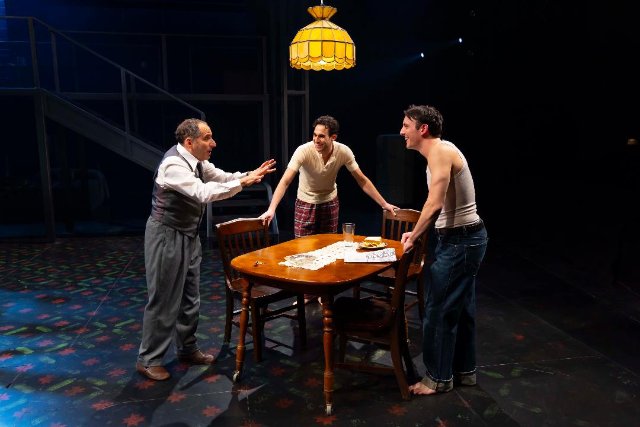
Your reaction to the scenic design (by Sara Brown) will be influenced by your reaction to Bensussen’s staging of many of the flashback scenes. Productions of the play seldom have a fully realistic set; it is, after all, a memory play. But this set features a metal skeleton of a house in the middle of the stage. The result is that some action that takes place at the rear of the stage is obscured. Does Bensussen want it only partly visible? Perhaps, but if so, it is distracting. We see actors preparing for a coming scene.
Death of a Salesman is a memory play; Willy Loman, the central character, is an aging traveling salesman whom the world has passed by. As his life unravels, he seeks respite and meaning through flashbacks from 18 years earlier, when his sons Biff and Happy were on the brink of adulthood. Nothing has turned out as he expected, and he questions the decisions he made. Should he have taken the opportunity to go to Alaska and work for his older brother?
The play is also Miller’s condemnation of the American Dream and American capitalism, which discards people as they get older. Willy, who has worked for one company for 34 years as their New England representative, has been pushed to the curb with barely a thank-you. Times have changed, the buyers he knew are long retired. While he and his wife, Linda, can be “free and clear,” about to make their last mortgage payment, there is no one to live in the house.
Miller uses the two sons, Biff and Happy, to contrast the two views of the American Dream. Happy is following in his father’s footsteps as a salesman seeking money, but with a severely deficient moral compass. His mother calls him a bum, and it is an accurate description of the womanizing man. Biff threw away every opportunity he had but has finally realized that the American Dream leads only to unhappiness. He is finally growing up and figuring out who he is
.When it comes to the performers, Samuel H. Levine, playing the older son, Biff, started slowly, but hit his stride in the second act. The penultimate scenes with his father are heartbreaking.
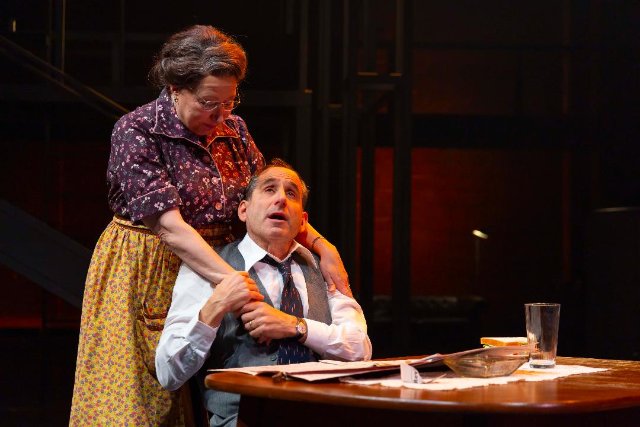
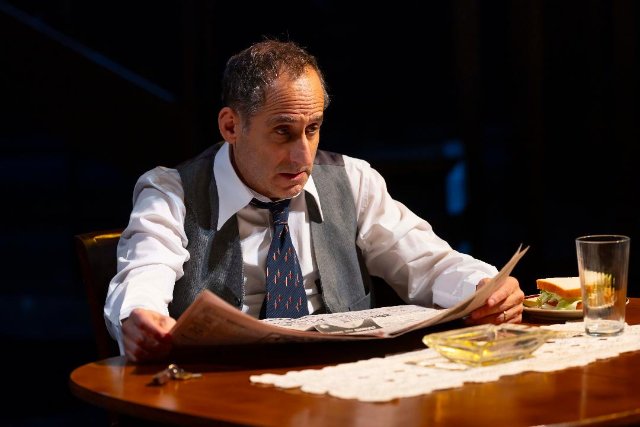
Peter Jacobson gives Willy a nervous energy that conveys his uncertainty. This is a difficult role; Willy is not a hero by most definitions. Plus, he is a man who is defeated and spiraling into depression and despair. He sees no way out. Jacobson effectively conveys most of this. If I had to compare his performance to one of the many I have seen, it would be Dustin Hoffman’s take on the role.
Unfortunately, some of the most famous and important lines in the play are not given their due. Towards the end of the First Act, Willy’s wife Linda (Adrianne Kretansky) is in a confrontation with her two sons, who are dismissive of him. She says: “But he’s a human being, and a terrible thing is happening to him. So attention must be paid. He’s not to be allowed to fall into his grave like an old dog. Attention, attention must be finally paid to such a person.” I blame Bensussen, that Linda says these lines with so little conviction or strength that I suspect many in the audience did not really hear them or understand their significance. Kretansky fails to balance Linda’s strength and her acquiescence; she loves this flawed man, and she is scared and angry at what is happening to him, but she also has an inner strength and understands more than Willy realizes.
I wish I understood Bensussen’s take on this role. I’ve seen numerous productions of this play with some of the finest actresses on the American stage as Linda.
Michael Cullen as Uncle Ben (some critics argue that Ben is a figment of Willy’s imagination), Paul Michael Valley as Willy’s neighbor Charley, and Patrick Zeller in the duo roles of Willy’s boss Howard and as Stanley, a waiter, are excellent. Zeller, in particular, brings empathy to the role of Stanley.
Max Katz as the womanizing Happy and Stephen Cefalu, Jr. as Charley’s son Bernard, are not as successful. Neither seems to fully embody the multiple dimensions of the roles.
The final moments of Willy’s last scene are brilliantly staged and designed; it was one of the best stagings of that moment (due to some terrific stagecraft) that I’ve seen.
A Death of a Salesman is at Hartford Stage through Sunday, March 29. It is well worth seeing. Tickets are at HartfordStage.org.
This content is courtesy of Shore Publications and Zip06.com