

Hell's Kitchen
Equity Touring Production in Ft. Lauderdale
By: Aaron Krause - Mar 12, 2026
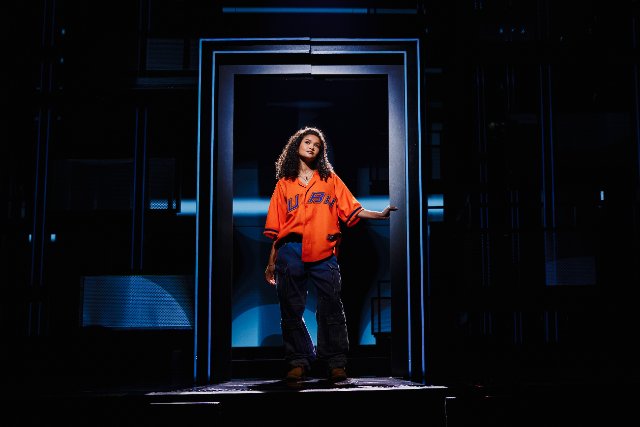

In a room within a New York City apartment complex, 17-year-old Ali encounters a special person who helps her discover her artistic voice and find her purpose.
Ali is the protagonist in Hell’s Kitchen, an electric and compelling jukebox musical loosely inspired by the youth of acclaimed singer-songwriter Alicia Keys. The coming-of-age story is playing at Fort Lauderdale’s Broward Center for the Performing Arts through March 22 as part of an invigorating Equity Broadway national touring production before heading to Tampa’s Straz Center, where it will run March 24–April 4.
The coming-of-age tale, which runs about two hours and 35 minutes, including an intermission, is not a direct autobiography. Instead, it presents a fictionalized story that draws on Keys’ experiences growing up in Manhattan’s Hell’s Kitchen neighborhood.
Under Michael Greif’s assured direction, the musical features a large, gifted cast of triple-threat performers who dance dynamically, sing with impressive vocal strength, clarity, and expression, and bring the Hell’s Kitchen neighborhood of the 1990s vividly to life.
In Manhattan Plaza, a famed two-tower apartment complex known for providing federally subsidized housing for artists, biracial Ali lives with her strict but well-meaning single mother, Jersey. The older woman, who wants to protect her daughter from bad influences, clashes with her independent-minded daughter. Ali becomes involved with Knuck, a drummer who doesn’t reciprocate her affection, and persists despite obstacles along the way. She eventually meets Liza Jane, a blunt, no-nonsense piano teacher whose influence on Ali is profound. As she immerses herself in piano with Jane’s guidance, Ali begins to recognize her path and mature.
While the songs (music and lyrics by Keys) are mostly well-known, the audience at the reviewed performance didn’t applaud merely upon hearing familiar lyrics. Instead, they seemed absorbed in the story, and the songs function as integral parts of the narrative rather than standalone nostalgic showcases. To be sure, the audience enthusiastically applauded the performers’ talent at appropriate times.
One of Jersey’s key songs is “Seventeen.” She sings it to express her concern about teenage impulsiveness. The song introduces the central conflict: Ali’s desire for independence against Jersey’s fear that her daughter will make dangerous mistakes. “Seventeen” is Jersey’s argument in musical form. Jersey sings: “It’s not cold, Ray, it’s facts. And it’s not just her, it’s all of them. They’re babies in grown-up bodies. They’re hormones in hoodies. But the rest of them are not my responsibility. She is.”
“Girl on Fire,” sung by the cast with palpable passion and strong backing from live musicians, comes during a key part of the show. At this point, Ali is discovering her musical talent, rebelling against her mother, and falling for Knuck. Within the narrative, the song conveys that Ali is brimming with youthful vigor and confidence, feeling unstoppable. It marks an emotional high point, where she feels powerful and in control.
“Perfect Way to Die” arrives at a pivotal moment as the emotional Act One closer. Performed by Jane, the song teaches Ali how to channel personal and societal trauma into music. After a tense, racially charged confrontation that ends with the police present, Ali is filled with rage and dread. Jane uses this dark moment to encourage Ali to pour her anger and despair into her music. The song conveys the harsh realities of racism and police brutality and hints that Jane lost a child to such violence but found emotional release through piano.
“Empire State of Mind” is the upbeat celebratory finale. It’s a climactic tribute to New York City and reinforces themes such as ambition and the city’s influence on Ali. The number punctuates the story of Ali finding her voice and place in Manhattan. As the cast performs the number vivaciously, images of New York City appear on a projector screen.
“Empire State of Mind” is a fitting tribute to New York City that, like the 1977 hit “New York, New York,” celebrates the Big Apple. Frank Sinatra’s version is unapologetically positive and hopeful, while “Empire State of Mind” acknowledges the city’s gritty side. The latter song references drug dealing and the “casualties” of the street that exist alongside the glitz of courtside Knicks seats.
Some songs in the show are high-energy, intense numbers with physical choreography and drumbeats. If you’re trying to catch every individual lyric during these songs, you may be disappointed. Yet even when the words are hard to make out, the performers consistently convey emotion, so we understand how the characters are feeling as they sing and dance. Speaking of movement, Camille A. Brown’s choreography, which includes spins and kicks, captures the spirited energy of the characters. Their fast, dynamic motions evoke the in-your-face hustle and bustle that has long defined New York City. While many numbers are big and loud, the show also features quieter, more reflective moments.
From a singing standpoint, the performers demonstrate impressive range, vocal control, strength, and expression. The live musicians provide rich accompaniment without ever drowning out the cast. At least once, Kennedy Caughell, who portrays Jersey, hits a sky-high “G” and holds the note for an impressive length of time, earning applause during the reviewed performance.
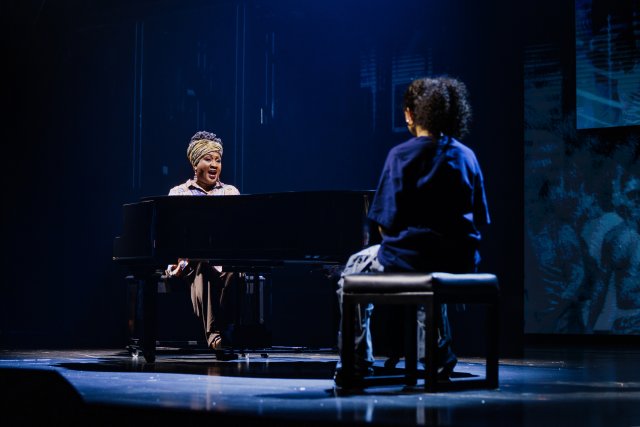
Roz White, who deftly portrays Liza Jane, boasts a honeyed and soulful voice that reminds this critic of Della Reese’s affecting vocals during Touched by an Angel. While speaking, White captures Jane’s unapologetically blunt, no-nonsense demeanor. With her sharp voice and commanding posture, White’s Jane calls to mind a proud woman who has been through a lot and earned the respect of others. Yet White balances firmness with a caring, encouraging personality that makes you think of your own real-life or fictional role models. Since White makes Jane firm yet likable, we genuinely mourn her loss after the character dies.
Another winning performance comes from Desmond Sean Ellington, who gives a warm and tender portrayal of Davis, Ali’s kind yet unreliable father. Listen to the gentle way he calls Ali “baby girl,” and it’s hard not to melt; we all want to hear his reassuring voice during difficult times.
The audience yearns to believe in Davis and hope that he’ll return and always be there for Ali and Jersey. But librettist Kristoffer Diaz, a Pulitzer Prize finalist, refuses to settle for a fairytale ending. Life, the show reminds us, often doesn’t deliver one. In the end, despite Davis’s earnestness—expressed through his sympathetic, supportive voice—he does not appear. But Ali’s maturity softens our disappointment: realizing Davis will not show up for a meal, the teen calmly notes that she made sandwiches just in case. This small act of planning reflects Ali’s growth and developing independence.
Maya Drake’s Ali, her dark hair tied in a bow and swinging as she moves, convincingly conveys her character’s restlessness and determination. The performer pairs Ali’s resolute speaking voice with forceful gestures that punctuate her decisiveness. Drake’s Ali moves as quickly as she speaks with a convincing New York accent, and the performer clearly conveys frustration without overacting. But Drake also captures endearing qualities, including Ali’s awkward bravado and persistence early on when she tries to ingratiate herself to Knuck. In the end, despite their arguing and hostility, Drake and Caughell leave us believing without a doubt that Ali and Jersey love each other.
While Ali’s dark hair is tied in a bow during the first act, after intermission the bow is gone, leaving her hair long and wavy. This visual change reflects Ali’s growing independence and emerging confidence. It signals her evolution from a controlled teenager to someone beginning to assert her own identity and independence.
As Ali’s helicopter single parent, Caughell’s forceful Jersey can be off-putting. When you hear her order Ali upstairs and point, you feel as though you’re listening to a strict parent of an unruly child. But Caughell’s Jersey also leans into her daughter, trying desperately to connect, and we sense both her ache to connect and her sincere regret after coming across as harsh.
JonAvery Worrell also delivers an impressively natural performance as Knuck. As Worrell portrays him, Knuck is one of the show’s quieter characters, but the performer injects him with unmistakable unfriendliness, making it clear he wants Ali to stop following him. That chilliness seamlessly melts into tenderness when the pair are on better terms. The two share a moving duet of “Unthinkable (I’m Ready).”
Director Michael Greif, who has helped shape intense and impassioned musicals such as Rent, Next to Normal, and Dear Evan Hansen, brings his expertise to yet another serious musical in Hell’s Kitchen. But he also finds the humor in the piece. The pacing is consistently fluid and varied, and his staging is smart.
Robert Brill’s minimalist scenic design suggests locales such as an apartment with just a couple of set pieces. Peter Nigrini’s projections flesh out the design by including images of the apartment building and of New York City. The set pieces slide on and off the stage, ensuring smooth transitions between scenes.
Natasha Katz’s lighting design includes smart use of hues such as red to convey passion. In addition, Katz’s realistic, intense lighting allows us to clearly see the performers and emphasizes key moments. Ascending reflections of light also suggest an elevator rising.
Dede Ayite’s costumes reflect the period and lend individuality to the characters, while Gareth Owen’s sound design is generally crisp and clear.
While the story in Hell’s Kitchen isn’t particularly original or groundbreaking, it’s a relatable, timeless tale with themes that resonate: parent-offspring relationships, coming of age, love and resilience, the power of art, the mentorship that shapes artistic growth, navigating the dangers of urban life, and the vibrancy of community.
Watching and listening to Ali confidently play the piano while seated next to Miss Liza Jane, you feel hopeful about the teen’s future. Despite obstacles in her life, Ali has found her true calling with guidance from a respected mentor. It’s the kind of outcome any parent would hope for his or her own child.
IF YOU GO
WHAT: An equity national touring production of “Hell’s Kitchen.”
WHEN: Through March 22.
WHERE: Broward Center for the Performing Arts, 201 S.W. 5th Ave. in Ft. Lauderdale.
TICKETS: Visit www.browardcenter.org or call (954) 462-0222. For more information about the equity touring production, visit https://hellskitchen.com.