

Masiko Kamiya's Vessels
At Gallery NAGA
By: NAGA - Feb 18, 2026
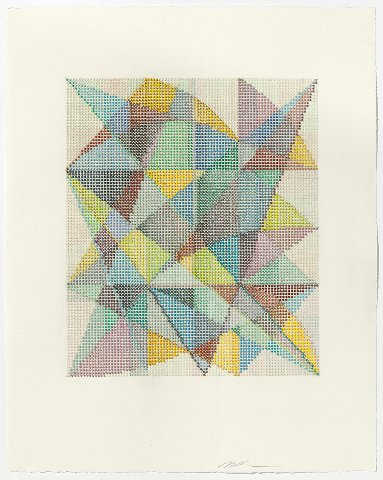
Gallery NAGA announces Vessels, a solo exhibition of new works by Masako Kamiya, running from February 27 through March 28, 2026, at 67 Newbury Street, Boston, MA 02116. An opening reception will be held on Saturday, March 7, from 1 to 3 pm, featuring informal artist remarks at 2 pm.
In this recent series of paintings, Kamiya offers a profound visual translation of the physical self, deeply rooted in her personal experience with bilateral hip dysplasia. As this ailment has grown more acute, her focus has shifted toward a search for dependable balance within the asymmetrical relationship.
The paintings function as biological maps where diminutive paint marks signify the countless cells and fibers that make up the body. This new body of work features complex compositions built upon underlying drawings of geometric forms. On a grid, Kamiya laboriously maps her marks over multiple trilateral shapes, creating a steadfast frame that houses the energy of the imperfect body and reflects a complex sensory experience of weight and gravity.
While her technique has subtly shifted over the past two decades, Kamiya continues to utilize a singularly unique mark-making process to create her paintings. Using acrylic gouache, she puts down a single dot of paint, lets it dry, and then adds another directly on top. She repeats this process until stalactites of differing heights emerge from the surface. Because each layer or dot is of a different color, the work, when observed from an angle, becomes a vibrant forest of multi-colored columns. These visual facets enhance the sculptural quality of the work and encourage the viewer to interact with it from every angle.
Kamiya’s work is also a quiet rebellion against the ephemeral nature of the digital world. In a landscape dominated by flickering images on a digital screen, she craves the paint’s color, opacity, weight, and a sense of reciprocity.
Her intention is to challenge the way a painting is conventionally perceived, forcing the viewer’s eyes to optically process various properties of color. Ultimately, the viewer experiences a subtle metamorphosis as the painting shifts from two dimensions to three dimensions and back again, according to the angle and distance from the work.