

Driving Miss Daisy
Collaboration between Palm Beach Dramaworks in Florida and Barrington Stage Company in Massachusetts.
By: Aaron Krause - Feb 15, 2026
The proud, independent woman who repeatedly barked “no” to her son when he suggested that someone drive her now struggles to use a fork in a nursing home. But the gentle, guiding hand of her best friend reaches toward her mouth as he feeds her Thanksgiving pie. The friend, who is hardly a youngster now either, no longer drives. Yet he is the same man who drove Daisy Werthan to her errands, worship services, and social gatherings for 25 years. With poise and patience over that quarter-century, he endured Daisy’s sharp words during tense times, celebrated with her during happy moments, and comforted her when she was confused.
These two best friends are Jewish widow Daisy Werthan and Black chauffeur Hoke Colburn. They are central characters in Alfred Uhry’s Pulitzer Prize-winning play, Driving Miss Daisy, in a commendable production. It's a collaboration between Palm Beach Dramaworks (PBD) in West Palm Beach, Fla., and Barrington Stage Company (BSC) in Pittsfield, Mass. The production continues at PBD through March 1 before running at BSC from May 27–June 21.
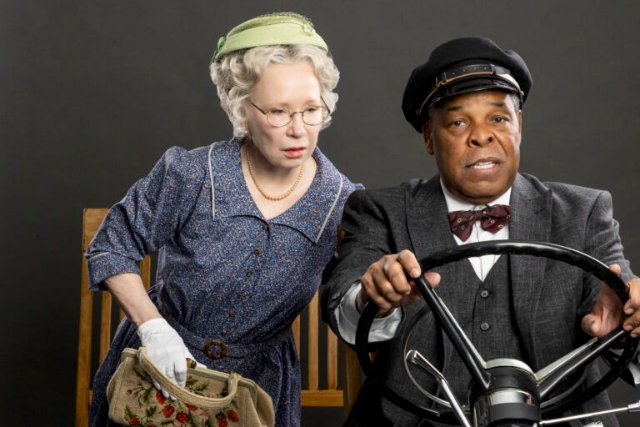
Under Julianne Boyd’s thoughtful direction, the production stars veteran stage and screen actors Debra Jo Rupp as Daisy, Ray Anthony Thomas as Hoke, and six-time Carbonell Award-nominated South Florida performer Matthew W. Korinko as Daisy’s son, Boolie. The actors largely shine, although their depiction of a southern accent could be stronger.
The American classic begins in 1948 Atlanta, Ga., after 72-year-old Daisy suffers a minor car accident. Boolie strongly suggests that his mother allow a chauffeur to drive her, but Daisy resists. Nevertheless, Boolie persists, hiring Hoke Colburn to take the wheel. Hoke is a patient and devoted man who, over the next 25 years, becomes indispensable to Daisy. Early on, their interactions are tense—Daisy is impatient, sharp, and fiercely independent, while Hoke is easygoing, accommodating, and unflappable. These early scenes set the tone for a touching, relatable tale that deftly combines comedy and tenderness while examining aging, friendship, prejudice, time’s passage, and social change.
One of Hoke’s early successes is a hard-won victory. After about a week of Daisy insisting she’ll take public transportation to a grocery store, Hoke finally convinces her to let him drive. He marks the milestone by calling Boolie: “It only took me six days. Same time it took the Lord to make the world,” he quips. Such wry one-liners keep the audience engaged while setting the stage for the more serious moments that follow.
Even after Daisy allows Hoke to drive, peace does not reign between them. On the way to the Piggly Wiggly, Daisy is a back-seat driver, micro-managing to a degree that would quickly irritate a less patient person: “You’re going the wrong way, don’t park in the sun, it fades the upholstery, slow down.” And when they reach the grocery store, Daisy demands the car keys.
In PBD and BSC’s co-production, the attention to detail is impressive. For instance, Daisy doesn’t look at Hoke when she demands the keys. While looking the other way, she thrusts out her arm and opens her hand as though she is a strict parent insisting her chronically misbehaving child hand over a video game. Despite Daisy’s stubbornness, Hoke’s calm demeanor keeps situations from boiling over. But, like anyone else, he has a breaking point. When Daisy rebukes him on a car trip for not going to the bathroom during an earlier stop, Hoke stops the car forcefully and yells, “I know when my bladder is full!” He then steps out of the car to relieve himself in the bushes—a brief but poignant reminder of the indignities imposed by segregation laws in the South.
At another point, we learn that someone bombed Daisy’s temple, preventing her from attending services. With the rise in antisemitism and increased violence against Jewish people, this is particularly unsettling to hear in 2026. Hoke’s observation about shared prejudice accentuates the connection between these characters and reminds us how intolerance affects everyone.
Over the quarter-century of the play, Daisy and Hoke’s relationship oscillates between tension and warmth, mirroring the broader social and racial changes of the era. In one cemetery scene, the air is warm, and their rapport has thawed. Daisy, tending her husband’s grave, hands Hoke flowers to place at a friend’s final resting place. He approaches the task with modesty and embarrassment, and Thomas captures the nuance beautifully.
Daisy, a former teacher, instructs Hoke firmly but encouragingly: “If you know your letters, you can read. I taught some of the stupidest children God ever put on the face of this earth. And all of them could read well enough to find a name on a tombstone.” Hoke’s face brightens as he realizes the significance of his accomplishment.
Just as Daisy helped him, Hoke makes himself available for Daisy. For instance, he brings her coffee during an ice storm. He could have stayed home when travel would have been dangerous, but he’s clearly thinking about Daisy and the fact that she’s alone. With affection, Daisy responds, “How sweet!” They sit next to each other during the scene, a contrast to the beginning of the play when they were apart under Boyd’s smart staging. When she talks to Boolie on the phone, she describes Hoke as “handy.” Her son then sarcastically suggests that he must have the wrong number. “I didn’t say I love him, I just said he’s handy,” Daisy responds.
At another point, near 90, Daisy panics, thinking she’s late for school and can’t find her papers. Using a cane, she moves quickly, looking all over and gesturing, her voice unmistakably anxious. Hoke leans in with concern, sympathetic yet steady. He manages to calm her down, and they remain seated next to each other. Suddenly, Daisy warmly tells him, “You are my best friend.”
“Really?” Hoke says, obviously touched.
“You are,” she responds, touching him. A hug might have underscored the moment, but the affection between them is already unmistakable.
Rupp and Thomas share strong chemistry, with moods shifting seamlessly throughout. The actors are also compelling individually. Thomas embodies a thoughtful, easygoing man who is slow to anger but erupts when pushed too far. He also charts Hoke’s aging convincingly. Toward the end, his back is hunched and his movements are slower, subtly conveying the passage of time.
At the start, Rupp’s Daisy is a proud, stubborn woman with seemingly endless energy. She walks effortlessly and speaks with a sharp, clipped voice that gradually softens and becomes tender during the play’s most moving moments. But before long, she needs a cane, and her movements slow. Still, for the most part, she remains mentally sharp. When a cane is no longer enough, she enters the final scene slowly, using a walker.
Tears formed in this critic’s eyes as it became clear that although many years had passed, these characters had remained together. At least one of the cars in which Hoke drove Daisy has long since been discarded. Daisy is no longer the vibrant woman we first met at 72. By the final scene, she is 97. Yet she still doesn’t mince words. “Hoke came to see me, not you,” she tells Boolie, who calls her a “doodle.”
Speaking of Boolie, Korinko believably portrays an image-conscious, polished man who dresses well and speaks carefully and eloquently. With glasses perched on the bridge of his nose, dark, receding hair, and a dark suit, he looks every bit the professional. Korinko also makes Boolie’s nervous energy believable. He is intense and impatient, yet the actor’s gestures, movements, and speech feel natural and unforced. While Korinko’s Boolie can be sarcastic, deep down he loves his mother. At one point, he kisses her. One minor shortcoming: Korinko’s Boolie doesn’t appear to age over the 25 years depicted; subtle aging makeup or a grey wig would have sufficed.
The actors perform on Bert Scott’s detailed period set, which encompasses three different locations: Daisy’s house, on the road in the car, and Boolie’s office. Having the locations side by side allows scene transitions to unfold seamlessly. For a car, this production uses a dark flat surface onto which artists have added headlights, a chair, a bench, and a steering wheel. The structure effectively suggests a car without forcing the company to bring a real one onstage.
Tim Brown’s projection design includes photos that enhance the realism of the sets on stage. However, images of clouds feel out of place—they’d be more appropriate if the characters were flying in an airplane.
John Wolf’s realistic lighting illuminates the actors and scenery, Brian O’Keefe’s period costumes suit each character, and Alexander Sovronsky’s sound design renders each spoken word clear and audible.
Driving Miss Daisy premiered off-Broadway in 1987, yet it feels far from dated. It highlights themes that are as relevant today as when the play debuted. The play is part of Uhry’s “Atlanta Trilogy,” three works that explore aspects of the Jewish experience in Uhry’s hometown. The other works are The Last Night of Ballyhoo, set in 1939 and revolving around a wealthy Jewish family preparing for a social event amidst the backdrop of the premiere of Gone with the Wind and the outbreak of World War II, and Parade, a musical dramatization of the 1913 trial and imprisonment and 1915 lynching of Jewish American Leo Frank in Georgia.
Uhry is the only American playwright to have won a Pulitzer Prize for Drama (Driving Miss Daisy, 1988), an Academy Award for Best Screenplay Adaptation (Driving Miss Daisy, 1990), and the Tony for Best Book of a Musical (Parade, 1999). Uhry’s nuanced characters, thematic depth, and poignant, character-driven narratives have set him apart. In his introduction to Driving Miss Daisy, Uhry explains why the play has resonated with audiences: “I wrote what I knew to be the truth and people have recognized it as such.”
Driving Miss Daisy reminds us that true friendship endures—and that people share more in common than the differences that separate them. We leave the theater feeling the warmth of Daisy and Hoke’s bond, reminded to hold fast to those we love, and encouraged to get to know people who are different from us.