

Weinberg's Passenger at Opera Frankfurt
We Must Not Forget
By: Susan Hall - Feb 10, 2026
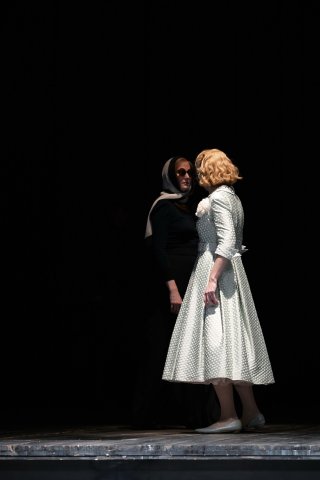
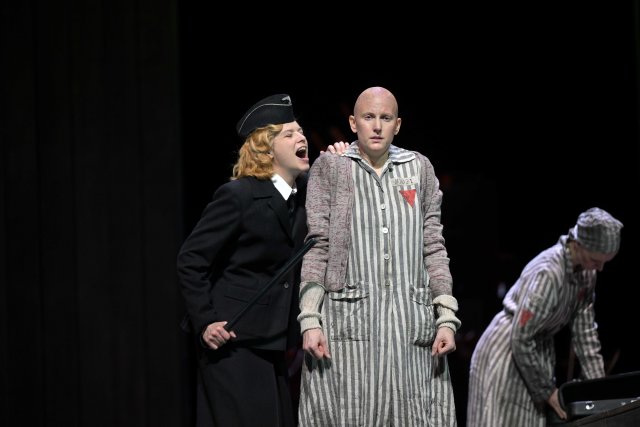
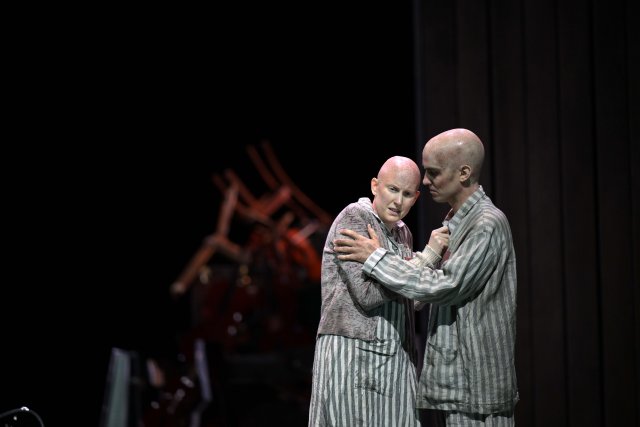
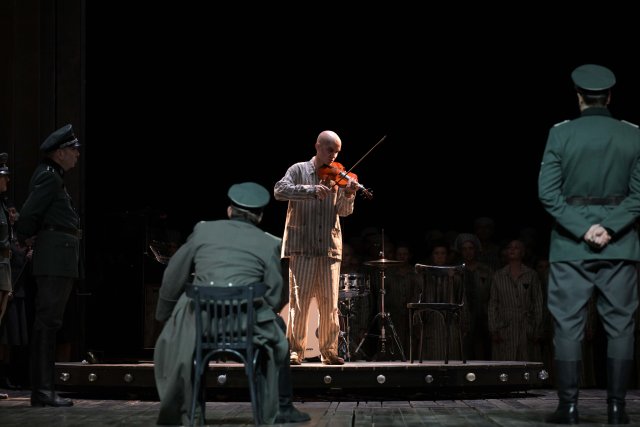
Opera Frankfurt gives a commanding and deeply engaging performance of The Passenger by Mieczysaw Weinberg, with a libretto by Alexander Medvedev. Dmitri Shostakovich, a close friend of the composer, read Zofia Posmysz’s novel and immediately saw its potential as an opera. Weinberg agreed and went on to write what he considered the best of his seven operas. The Soviet government suppressed it.
The power of the work is immediately evident in Frankfurt. The orchestra conducted by Leo Hussain, grabs us with growls, deep drum beats, and racing horns.
On stage, a German diplomat and his wife are traveling to Argentina. Lisa, the wife (sung with ineffable beauty by Katharina Magiera), has not told her husband her full story. It catches up with her in the figure of Marta, who haunts her. Once a warden at Auschwitz, Lisa feels responsible for Marta’s death. Yet here she is — alive? And about to expose the real Lisa, and perhaps ruin her life. Anselm Weber directs to highlight the mysterious and ever-present power of memory.
We never know in this production (though we do in the novel) whether Marta was in fact killed at Auschwitz. She surely lives on evoking a profound feeling of guilt. As Florian Henckel von Donnersmarck showed us in his take on painter Gerhard Richter’s life, we can never look away. We can never get away.
What makes this opera unusual is its perspective. The author of the underlying book and Weinberg both lived surrounded by German death sentences. This is an insider’s point of view. Weinberg fled Poland for Russia when Hitler marched into his country. Zofia Posmysz was imprisoned at Auschwitz as a political objector, not as a Jew.
The set by Katja Haas in the Frankfurt production reflects this duality. A luxury liner is created with planks arranged around the outside of a large cube. When the cube rotates, the interior of the Auschwitz prison is revealed. The diplomat wanders through this past as the story is told. It is ever-present.
Weinberg’s music is equally present. A.J. Gluekert as the diplomat Walter weaves well between his love of his wife and dread of her past. Perhaps because the “bad” character, Lisa, has a conscience and a heart, Katharina Magiera has some very beautiful lines. Amanda Majeski is both brave and tormented as Marta, a role she created in Chicago. Most of the score is cacophonous, sounding out the horrors the camps held.
The lighting by Olaf Winter is particularly important, giving us bright light on the ship’s deck and deep siennas and greys in the camp. The positioning of the inmates is another powerful element: women are distributed across the floor, sitting, lying down, crunched in fear, yet sustained by faint hope.
Anthony Freud produced a multilingual version of the opera in Chicago a decade ago. His mother was an Auschwitz survivor, and he observes that when what happened there is spoken about openly, the second-generation syndrome so common in families of Holocaust survivors does not develop.
There is a suggestion in the opera that we too must constantly look — remain vigilant, acknowledge the horrors around us, and try to prevent their repetition. In Germany, the mounds of World War II debris are silent. The stumble stones commemorating the lives of murdered Jews are silent. This opera is not. It has a powerful auditory presence. The music belongs to the story in a special way.
And Frankfurt Opera, with glorious singing and acting, striking staging, and brilliant lighting, has made The Passenger an unforgettable work.